

AI content repurposing is the bomb… when it’s done right.

You’ve written a solid blog post. Now you want to turn it into social content, an email, maybe a LinkedIn post. So you ask ChatGPT to “repurpose this into a LinkedIn post” and what you get back sounds like a corporate announcement written by someone who’s never met you.

That’s not an AI problem. That’s an input problem.

Too many people treat AI like a vending machine, just press B4…. and while it sounds easy they’ll get the same snack as everyone else. They feed it vague instructions (“make this sound professional”) and then bitterly wonder why the output tastes like LinkedIn thought leader garbage. AI content repurposing will of course produce bland output when you give it generic instructions.

Plenty of mainstream advice tells you to “just add your brand voice” after the fact. That’s backwards. Voice extraction needs to happens before you generate anything, not during cleanup.

The one thing to nail before you touch any AI tool

Define what your voice actually is.

Not what you think it should be. Not “professional but approachable.” What does your voice sound like when you’re explaining something to a mate over coffee? When you’re annoyed on behalf of your clients? When you’re calling out something that frustrates you?

Collect real examples:

  • Emails you’ve sent where people replied “this is so you”
  • Voice notes where you weren’t performing
  • Rants in your Notes app
  • Client conversations where you felt like yourself

Your brand voice already exists in your unfiltered communication. Stop inventing it from scratch. Extract it from what’s already there. This is voice extraction over voice creation, and it’s the difference between AI that sounds like you and AI that sounds like a template.

How to train AI on your actual voice (not generic “professional”)

Once you’ve collected examples of your real voice, you need to teach the AI what patterns matter.

Create a voice reference document that includes:

  • 3-5 writing samples that sound unmistakably like you
  • Sentence rhythm notes (short and punchy vs long and winding)
  • Words and phrases you actually use
  • Words and phrases you’d never use
  • Your stance on common topics in your industry

Then, when you’re ready to repurpose content with AI, you feed this into your prompt alongside the original piece. Not as an afterthought. As the foundation.

Here’s what doesn’t work: “Make this sound like me.” The AI has no idea who you are.

Here’s what does: “Using the voice patterns in the attached reference doc, rewrite this blog intro for LinkedIn. Keep the same contractions, sentence variety, and directness. Avoid corporate jargon.”

Specificity is your friend. Vague prompts get vague outputs. Vague is not your friend.

A prompt framework that stops bland content before it starts

Every effective content repurposing strategy follows this structure:

  1. Context: What’s the original format and goal?
  2. Voice anchor: Reference your voice doc or paste 2-3 example sentences
  3. New format requirements: Length, platform, tone shift if needed
  4. Constraints: What to avoid, what must stay
  5. Output instruction: Specific format (bullet points, paragraphs, script)

Example: “This is a 1200-word blog post about AI prompting [paste excerpt]. My voice is conversational, direct, uses contractions, and avoids corporate speak [paste voice sample]. Turn this into a 150-word LinkedIn post that leads with a bold statement, not a question. Avoid phrases like ‘unlock potential’ or ‘digital landscape.’ Write in second person.”

That’s a prompt that does the work upfront so you’re not spending 20 minutes editing robot speak later.

Turn one core piece into eight formats without copy-paste energy

Once you’ve nailed your prompt, repurposing becomes a system, not a slog.

One blog post becomes:

  • Email newsletter (reframe the hook, tighten the body, softer CTA)
  • LinkedIn carousel (pull key points, add visual hierarchy)
  • Instagram caption (lead with the strongest insight, trim to 300 words)
  • Twitter thread (break into punchy statements, one idea per tweet)
  • Short video script (conversational intro, three main points, question to close)
  • Email sequence (split into problem/solution/action across 3 emails)

The AI handles structure and length adjustments. You handle voice calibration and platform-specific tweaks. Batch your prompts, generate all formats in one session, then edit with fresh eyes.

This is how you scale content creation without burning out or sacrificing authenticity.

When to let AI run vs when to grab the wheel back

AI is brilliant at structure, terrible at nuance.

Let it handle:

  • Format conversions (blog to email, post to thread)
  • Length adjustments (long to short, short to expanded)
  • Idea generation (10 ways to angle this topic)
  • First draft speed (get words on the page fast)

Grab the wheel for:

  • Opening hooks (AI defaults to questions, you need statements)
  • Personal stories or examples (AI invents, you lived it)
  • Controversial stances (AI plays it safe, you don’t)
  • Final polish (sentence rhythm, word choice, personality injection)

The editing checklist that saves your brand: Read it aloud. If you wouldn’t say it, rewrite it. If it sounds like it came from anyone else, bin it. If a sentence has no job, cut it.

AI is a tool, not your replacement. It gives your words speed. You give your words soul. That combination is how you maintain brand voice while scaling output without the Sunday night content scramble.

Sound like yourself. On purpose. Every time.

Can AI maintain my writing style when repurposing content?

Yes, but only if you train it properly. AI doesn’t inherently know your voice. You need to provide specific voice samples, clear constraints, and detailed prompts. Generic instructions produce generic outputs. When you give AI concrete examples of your actual communication patterns, it can replicate tone, rhythm, and word choice effectively.

How do I repurpose content without sounding generic?

Start with voice extraction, not voice creation. Collect examples of your real communication (emails, voice notes, unfiltered writing), then create a voice reference document. Use this in every prompt alongside specific format requirements and constraints. The key is detailed and purposeful prompting upfront, not endless editing afterward.

What’s the best way to scale content creation with AI?

Build a repeatable system: define your voice clearly, create prompt templates for each format (email, social, blog), batch your content generation in focused sessions, then edit for personality and platform-specific nuances. Let AI handle structure and speed; you handle voice calibration and authenticity checks.

Can AI content sound authentic?

Only when you make it. AI outputs are only as good as your inputs. Vague prompts produce bland content. Detailed prompts with voice anchors, specific constraints, and clear format requirements produce content that reflects your actual communication style. Authenticity requires human oversight and final polish.

Want to Know Why Most AI-Generated Content Fails to Build Authority?

The same tools that could help you build topical authority faster than ever are also the tools producing most of the content that’s quietly killing it.

The pattern goes like this. A small business owner reads that they need to publish more. They open ChatGPT, ask for ten blog post ideas on their topic, pick the three that look easiest, generate them all in a single afternoon, and publish them across the next fortnight. The posts are technically fine. Grammar’s correct. Word count’s respectable. There are even some bullet points and a closing sentence that says “in conclusion.”

Google’s response? A polite nothing.

This is the part most AI content marketing advice skips over. AI-generated content fails to build authority for three specific reasons, and none of them are about the AI itself. They’re about how it’s being used. The first failure is topical noise instead of topical depth. Ten posts on vaguely related topics is noise. Ten posts that interconnect around one defined subject is depth. Most AI workflows produce noise because nobody’s mapping the subject first.

The second failure is missing E-E-A-T signals. Google’s quality systems look for evidence of experience, expertise, authoritativeness, and trustworthiness. AI on its own provides exactly none of these. It can rephrase what already exists. It can’t tell Google about the time you lost a client because of a hallucinated case study, or what you learned the month you tripled your retainer rates and lost half your roster. Those signals only come from you.

The third failure is structural sameness. When everyone in a niche uses similar tools with similar prompts, the output starts looking eerily uniform. Same headings, same sentence rhythm, same vague “in today’s fast-paced digital landscape” energy. Google’s systems are increasingly good at detecting this pattern, and so are readers. If you want to understand why this happens at the prompt level, there’s a missing ingredient in most AI prompts that’s worth knowing before you go any further.

The Framework: Pillar + Cluster + Internal Linking, Done With AI as Your Research Partner

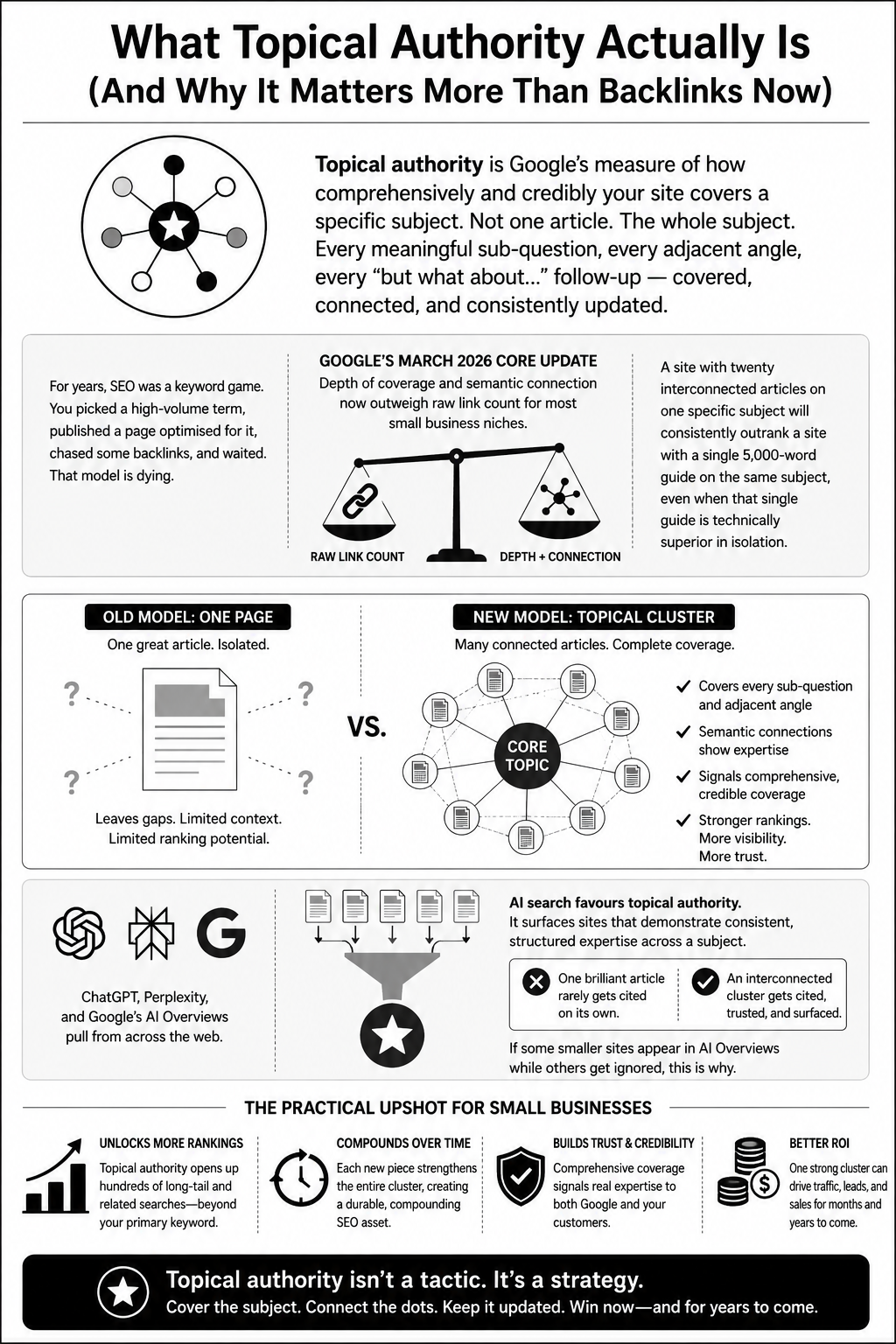
The model that works in 2026 is hub-and-spoke. One comprehensive pillar page on a broad topic, supported by a cluster of focused articles that drill into specific subtopics, all interlinked so search engines and readers can navigate the relationships easily.

A pillar article covers the broad topic comprehensively but not exhaustively. It’s the entry point. It sets up the territory and links outward to the cluster articles that go deeper on each sub-area. Cluster articles each target a specific long-tail question and link back to the pillar, and where it makes sense, to each other. The whole thing functions as a network. Authority compounds across the entire cluster rather than being trapped in one isolated post.

This is where AI earns its keep. Building a topical map manually – the kind of map that identifies every meaningful subtopic in a subject – takes hours of competitor analysis, keyword research, and “people also ask” mining. AI can compress that into a fraction of the time. Hand it your topic, ask it to map the subject space, and you’ll get a starting structure in minutes that would have taken a full day of solo research.

Here’s where it gets nuanced, though. The map AI generates is a starting structure, not the finished article. It will miss the angles only you know, the questions your clients actually ask, the objections nobody’s talking about. That’s the human’s job, and it’s the difference between a cluster that ranks and a cluster that disappears into the noise.

Step-by-Step: How to Brief AI for Topical Depth (Not Topical Noise)

The instinct most people have when they sit down to plan content with AI is to ask for blog post ideas. It’s the wrong starting move and just generates surface-level suggestions disconnected from any deeper structure.

Try this sequence instead.

Step one: define the subject, not the article. Tell AI the exact subject you want to own. Not a keyword. A subject. “I want to be the authority on AI content strategy for solopreneurs in service-based businesses” is a subject. “AI content” is a keyword. The difference matters because subjects have natural boundaries and sub-areas, and AI can map them.

Step two: ask AI to produce a topical map. Get it to list every meaningful sub-area of that subject, then every sub-question within each sub-area. You want depth here. A good map for a tightly defined subject can have fifty to a hundred individual content angles before you start pruning.

Step three: overlay your own knowledge. This is where the human absolutely has to lead. Go through the map and mark every angle where you have specific experience, an opinion that goes against the grain, original data, or a lived example. These become your priority pieces. They’re the ones AI literally cannot produce alone, because the source material isn’t in its training data… it’s in your head.

Step four: design the cluster architecture. Pick the pillar topic. Pick five to seven cluster articles that genuinely support it. Map the internal links between them before writing a single word. Without this step, you’ll end up with articles that orbit each other vaguely without ever connecting.

Step five: brief each piece individually. Generic prompts produce generic content. For each article, write a brief that includes your unique angle, the specific reader you’re writing for, the exact internal links you want included, and a few real examples or stories only you could tell. The brief is the contract, and if your brief is bland, your content will be too. A solid human-first AI content framework makes this part faster than you’d expect.

Where the Human Absolutely Must Lead

There’s a temptation to let AI do all of it. Briefs, drafts, edits, the lot. Resist it.

The parts of content that build topical authority are almost entirely human parts. Original opinion that takes a clear stance is human. Real client examples and lived experience are human. Industry observations that haven’t been published yet are human. The contrarian read on why the dominant advice is wrong is human. Voice (actual recognisable voice) is the most human of all.

When clients come to me frustrated that their AI content isn’t moving the needle, the diagnosis is almost always the same. They’ve outsourced too much to the machine. The AI is doing the thinking and the human is doing the editing, when it needs to work the other way around. AI for scale, structure, and research. Human for opinion, originality, and judgement.

This isn’t a moral position. It’s a strategic point. Google’s E-E-A-T signals are looking for evidence of genuine experience. AI can’t fake that. If your content reads like a tidy synthesis of what’s already on page one of Google, you’ve added nothing to the topic, and the algorithm will treat you accordingly. Building authentic AI brand voice training is the single most important thing you can do before scaling AI-assisted content.

Common Mistakes That Quietly Kill Authority

A few patterns show up repeatedly when small businesses try to build authority with AI and don’t see results.

Publishing volume without coherence is the loudest failure mode. Twenty posts on twenty different angles of “small business marketing” doesn’t build authority on anything. It diffuses the topical signal across too broad a surface. Better to publish six posts that all clearly support one defined subject than twenty that don’t.

Skipping semantic relationships between pieces is the second one. If your pillar article doesn’t link to your cluster articles, and your cluster articles don’t link back to the pillar or to each other, Google can’t see the structure. To the algorithm, you’ve published twenty isolated pages, not a coherent topical cluster.

Treating AI as the writer rather than the assistant is the third. The voice ends up identical across posts because the prompts are identical, the structure is identical, and the personality is missing. Readers feel it before search engines do. Bounce rates go up, time on page drops, return visits stop happening, and Google’s behavioural signals tell the algorithm to deprioritise the site.

Ignoring content freshness is the slow killer. Authority isn’t static. A site that published thirty excellent articles in 2024 and nothing since is less authoritative than one consistently publishing into 2026. The cluster has to be maintained, updated, expanded. This is where AI’s speed becomes genuinely valuable: refreshing existing content and adding new cluster pieces is exactly the kind of work AI can accelerate without compromising quality.

Chasing keywords instead of intent rounds out the list. Optimising heavily for keyword phrases at the expense of actually answering the reader’s question is a leftover instinct from the 2018 SEO playbook. Modern semantic search rewards content that maps to intent, not content that crowbars phrases into headings.

A Realistic Timeline for Seeing Authority Compound

Here’s the truthbomb nobody loves hearing. Topical authority does not happen in six weeks.

Realistic numbers, drawn from sites that have actually executed this strategy: content clusters typically start showing measurable traffic shifts at the three to six month mark, and authority signals compound noticeably over a six to twelve month window. Sites that sustain consistent cluster publishing for twelve months or longer commonly see traffic increases in the 40 to 80% range, with some businesses reporting much higher when they were starting from a low base.

That sounds slow because, by AI-content-mill standards, it is. The trade-off is durability. A site that builds genuine topical authority survives Google core updates. A site built on AI-generated keyword filler does not.

If you’re starting from scratch, the first sixty days are spent on planning and the initial pillar. The next ninety days build out the supporting cluster. From there, monthly publishing maintains momentum, and updates keep the cluster fresh. By month nine to twelve, the compounding effect kicks in, and the cluster starts ranking for keywords you didn’t even directly target, that’s the signal that semantic authority has actually built.

Frequently Asked Questions

How is topical authority different from domain authority? Domain authority is a third-party metric that estimates a site’s overall ranking strength based on backlinks. Topical authority is Google’s internal measure of how comprehensively and credibly your site covers a specific subject. A small site with high topical authority on a narrow subject can outrank a large site with high domain authority but shallow coverage. For small businesses, topical authority is the more achievable and more valuable goal.

Can I use AI to write the entire cluster, or do I need to write it myself? You can use AI for drafting, structuring, and research support, but the original thinking, opinion, and lived examples have to come from you. Pure AI output doesn’t satisfy Google’s E-E-A-T signals or carry the voice that builds reader trust. The most effective workflow is AI-accelerated drafts that you substantially shape, edit, and infuse with your own expertise and personality.

How many cluster articles do I need to support a pillar? Five to seven well-executed cluster articles is enough to start building genuine topical signal for most small business niches. The number matters less than the coherence. Seven articles that all clearly support and link to a single pillar will outperform twenty articles scattered across loosely related topics. Expand the cluster as you identify genuine sub-questions worth answering.

Will AI search engines like ChatGPT and Perplexity cite my cluster content? AI search systems favour sources that demonstrate consistent, structured expertise across a subject. Interconnected cluster content is more likely to be cited than isolated articles for exactly the same reason it ranks better in Google, it shows the AI that your site is a comprehensive resource on that topic. The structural cues that build SEO authority also build citation likelihood in AI Overviews.

What’s the biggest mistake small businesses make when starting a content cluster? Defining the subject too broadly. “Marketing” is not a subject you can own. “Email marketing for solo bookkeepers in Australia” is. The narrower and more specific the subject, the faster topical authority builds. Most small businesses try to compete on subjects that are far too broad for their resources, then wonder why nothing’s moving. Narrowing the focus is almost always the highest-impact fix.

The Bottom Line

Using AI to build topical authority isn’t about producing more content faster. It’s about producing the right content, in the right structure, with the right human signal woven through it. The businesses winning this game in 2026 are using AI to accelerate the parts AI is genuinely good at – research, mapping, structural drafting – and protecting the parts only humans can do, which is everything that makes a piece of content recognisably theirs.

If your AI content has been working harder than you and getting less back, the fix is rarely more AI. Usually it’s better strategy and a clearer human voice underneath. If you’d like a structured way to find out where your current content is leaking authority, the Content Bottleneck Quiz is a fast diagnostic to start with, and the YOU-BOT build is the next step if you’re ready to bake your voice into an AI that actually sounds like you.

Related Posts

How to Use AI to Build Topical Authority: The Smart Content Strategy Most Small Businesses Are Getting Wrong

How to Use AI to Build Topical Authority: The Smart Content Strategy Most Small Businesses Are Getting Wrong

Quick Answer: TLDR Using AI to build topical authority means letting AI handle research, structure, and scale while you lead with original experience, opinion, and lived examples. The strategy that works is pillar-plus-cluster content with strong internal linking:...

read more