

Why Does AI Content Sound So Generic and Robotic?

You’ve been using ChatGPT (or Claude) for months now. Your content calendar is finally full. Your drafts actually get finished.

And yet….

Everything sounds like it was written by the same polite, impossibly helpful assistant who’s never had a strong opinion about anything. Your emails read like corporate memos. Your social posts sound like motivational posters. Your blog content is technically correct… though completely forgettable.

This isn’t an accident. AI content sounds generic because large language models are trained to produce statistically probable word sequences. They replicate patterns from millions of existing texts, which means they default to the most common phrasing, the safest tone, and the blandest possible expression of any idea. If ChatGPT doesn’t know your brand voice, it’s because you haven’t given it enough specific information to deviate from its training data.

The good news? You can fix this. Using AI without sounding robotic isn’t about abandoning it, instead it comes down to being more strategic with how you prompt, constrain, and edit the output.

Tip 1: Define Your Brand Voice Before You Prompt ChatGPT

Most people open ChatGPT and type something like “write a blog post about productivity tips” and wonder why the output sounds like a thousand other blog posts about productivity tips.

The issue isn’t the tool. The problem is how you are briefing it.

If you want AI to sound like you, you need to tell it what it means to sound like. Not vaguely. Specifically.

How to Add Personality to AI Writing

Start by documenting your actual voice. Pull up your last five emails to clients, your favourite social media posts, or that one newsletter everyone replied to. Look for patterns:

  • Do you use contractions or write more formally?
  • Do you swear occasionally or keep it clean? (hey, no judgement!)
  • Are your sentences short and punchy, or do you prefer longer, winding thoughts?
  • What words do you use repeatedly? What phrases feel distinctly yours?
  • What words would you never use?

Once you’ve identified these patterns, feed them to ChatGPT as context before asking it to write anything. Instead of “write a blog post,” try: “Write a blog post in a conversational, direct tone. Use short sentences. Avoid corporate jargon like ‘leverage’ or ‘solutions.’ Sound like someone who’s been doing this for years and has strong opinions.”

This is what the Brand Voice Prompt Playbook does systematically. It walks you through extracting your voice patterns and turning them into reusable prompt frameworks so you’re not starting from scratch every time.

Tip 2: Use Strategic Constraints to Guide AI Output

Here’s a counterintuitive truth: giving ChatGPT more freedom produces worse results. Constraints improve output.

When you tell ChatGPT to “write creatively,” it defaults to the most statistically common version of creative writing in its training data. That usually means flowery language, unnecessary metaphors, and a tone that sounds like a motivational speaker that’s had way too much coffee.

What Constraints Make ChatGPT Writing Better

Effective constraints are specific instructions that narrow ChatGPT’s options:

  • Length limits: “Keep paragraphs under 3 sentences.”
  • Banned words: “Never use ‘delve,’ ‘unlock,’ ‘harness,’ or ‘game-changer.'” (please!)
  • Structural rules: “Start each section with a question the reader is asking.”
  • Tone boundaries: “Sound helpful but sceptical. Like you’ve seen too many bad implementations to be overly optimistic.”

These constraints force your AI tool to work within tighter boundaries, which paradoxically produces more distinctive output. You’re not letting it fall back on generic phrasing because you’ve explicitly blocked those options.

This is prompt engineering best practices in action. The tighter your guardrails, the more the output sounds like it came from a specific human with specific preferences.

Tip 3: Apply Editing Checkpoints to Humanise AI Writing

Even with perfect prompts, AI tools will still produce sentences that sound vaguely off. This is where editing becomes non-negotiable.

The biggest mistake people make is treating AI output as finished content. It’s not. And it never will be.

It’s a first draft that needs human intervention to go from technically correct to actually engaging.

How to Edit AI Content to Sound Authentic

Use this AI content editing checklist on every piece before you publish:

  • Read it out loud. If you stumble or cringe, rewrite that bit.
  • Check for hedging language: “may,” “might,” “could potentially.” Delete it.
  • Look for unnecessary qualifiers: “very,” “really,” “quite.” Cut them.
  • Find any sentence that sounds like it came from a corporate handbook. Rewrite it like you’re explaining it to a friend.
  • Add at least one specific example, story, or reference that only you would know.
  • Check for repetitive phrasing. AI loves to reuse the same sentence structure. Mix it up.

This process takes five minutes per piece, at most. And, it’s the difference between content that gets skimmed and content that gets saved.

If you’re producing high-volume content and need systematic editing, the SEO Blog Writer Prompt Playbook includes built-in editing prompts that catch these issues before you even leave ChatGPT.

Tip 4: Master Prompt Hygiene for Authentic ChatGPT Content

Prompt hygiene is the practice of keeping your AI conversations clean, specific, and free from contradictory instructions that confuse the model.

Most people make ChatGPT worse over time by layering vague requests on top of each other in the same chat thread. You ask for a blog post, then ask it to “make it more engaging,” then “add some personality,” then “no, less formal.”

Each request dilutes the original instruction. ChatGPT starts averaging your contradictory asks, and the output becomes mush. It’s a trap.

How Do I Stop AI From Sounding Formal

To maintain AI brand voice consistency:

  • Start fresh conversations for distinct content types
  • Give complete instructions upfront instead of iterating vaguely
  • If the output is wrong, don’t ask ChatGPT to “fix it.” Rewrite your original prompt with more specific constraints
  • Keep a prompt template doc so you’re reusing what works instead of reinventing instructions every time

This is what separates people who get inconsistent results from people who’ve systematically solved the voice problem. The latter group treats prompting like a skill worth refining, not a random guess-and-check game.

Tip 5: Add Personality with Voice Examples and Real Stories

The fastest way to make ChatGPT sound more human is to show it examples of human writing you want it to emulate.

Instead of describing your tone, paste in three examples of your actual writing and say: “Match this style.”

AI Writing Voice Examples That Work

Good voice examples for ChatGPT or Claude include:

  • An email you wrote that got enthusiastic replies
  • A social post that performed unusually well
  • A paragraph from a blog post where you explained something in your own words
  • A voice note transcript where you were ranting about something you care about

ChatGPT will analyse sentence structure, word choice, rhythm, and tone. The output won’t be perfect, but it’ll be noticeably closer to your actual voice than generic prompting.

The other critical addition: real stories. AI content sounds generic partly because it lacks specific, lived experience. Every piece you publish should include at least one detail that could only come from you. A client example. A mistake you made. A conversation you had. Something concrete.

This is how to use ChatGPT for business without losing brand voice. Use AI for structure, pacing, and initial drafting, and then you add the specifics that make it unmistakably yours.

Before & After: Transforming Robotic AI into Authentic Content

Here’s what the difference looks like in practice.

Robotic AI output: “Implementing effective time management strategies can significantly enhance productivity and help professionals achieve their goals more efficiently. By prioritising tasks and eliminating distractions, individuals can optimise their workflow.”

Humanised version: “You’re not bad at time management. You’re just using a system designed for someone else’s brain. Here’s what actually works when you’ve got client calls, a dozen unread emails, and a content calendar that’s been empty for three weeks.”

The second version has a point of view. It acknowledges a real struggle. It sounds like a person who’s been there. See the difference?

This type of transformation doesn’t happen by accident. It happens because you’ve defined your voice, set constraints, edited ruthlessly, maintained prompt hygiene, and added specific examples that ground the abstract advice in reality.

Some Ready-to-Use Templates

If you want to skip the trial-and-error phase and start using ChatGPT or Claude without sounding robotic today, here are three very simple plug-and-play prompts:

For social posts: “Write a LinkedIn post in a conversational, direct tone. Keep sentences under 15 words. No corporate jargon. No ‘delighted to announce’ phrasing. Sound like someone who’s done this work for years and has specific opinions. Topic: [your topic].”

For blog content: “Write a blog section explaining [topic]. Use short paragraphs. Start with a specific problem the reader has right now. Avoid hedging language like ‘may’ or ‘might.’ Include one concrete example. Sound sceptical of generic advice.”

For emails: “Write an email to my list about [topic]. Conversational tone. Sound like you’re talking to one person, not a crowd. Keep it under 300 words. End with one clear next step. No fluffy intros.”

Be mindful that these are starting points. The more you refine them based on what works for your specific brand voice, the better your results get.

And if you’d rather have the whole system built for you, the suite of Prompt Playbooks give you ready-made frameworks for many content type. No guesswork. No starting from scratch. Just working frameworks you can jump into and use immediately.

Stop overthinking it. Start using AI in a way that actually sounds like you and notice the difference in your output and results!

Want to Know Why Most AI-Generated Content Fails to Build Authority?

The same tools that could help you build topical authority faster than ever are also the tools producing most of the content that’s quietly killing it.

The pattern goes like this. A small business owner reads that they need to publish more. They open ChatGPT, ask for ten blog post ideas on their topic, pick the three that look easiest, generate them all in a single afternoon, and publish them across the next fortnight. The posts are technically fine. Grammar’s correct. Word count’s respectable. There are even some bullet points and a closing sentence that says “in conclusion.”

Google’s response? A polite nothing.

This is the part most AI content marketing advice skips over. AI-generated content fails to build authority for three specific reasons, and none of them are about the AI itself. They’re about how it’s being used. The first failure is topical noise instead of topical depth. Ten posts on vaguely related topics is noise. Ten posts that interconnect around one defined subject is depth. Most AI workflows produce noise because nobody’s mapping the subject first.

The second failure is missing E-E-A-T signals. Google’s quality systems look for evidence of experience, expertise, authoritativeness, and trustworthiness. AI on its own provides exactly none of these. It can rephrase what already exists. It can’t tell Google about the time you lost a client because of a hallucinated case study, or what you learned the month you tripled your retainer rates and lost half your roster. Those signals only come from you.

The third failure is structural sameness. When everyone in a niche uses similar tools with similar prompts, the output starts looking eerily uniform. Same headings, same sentence rhythm, same vague “in today’s fast-paced digital landscape” energy. Google’s systems are increasingly good at detecting this pattern, and so are readers. If you want to understand why this happens at the prompt level, there’s a missing ingredient in most AI prompts that’s worth knowing before you go any further.

The Framework: Pillar + Cluster + Internal Linking, Done With AI as Your Research Partner

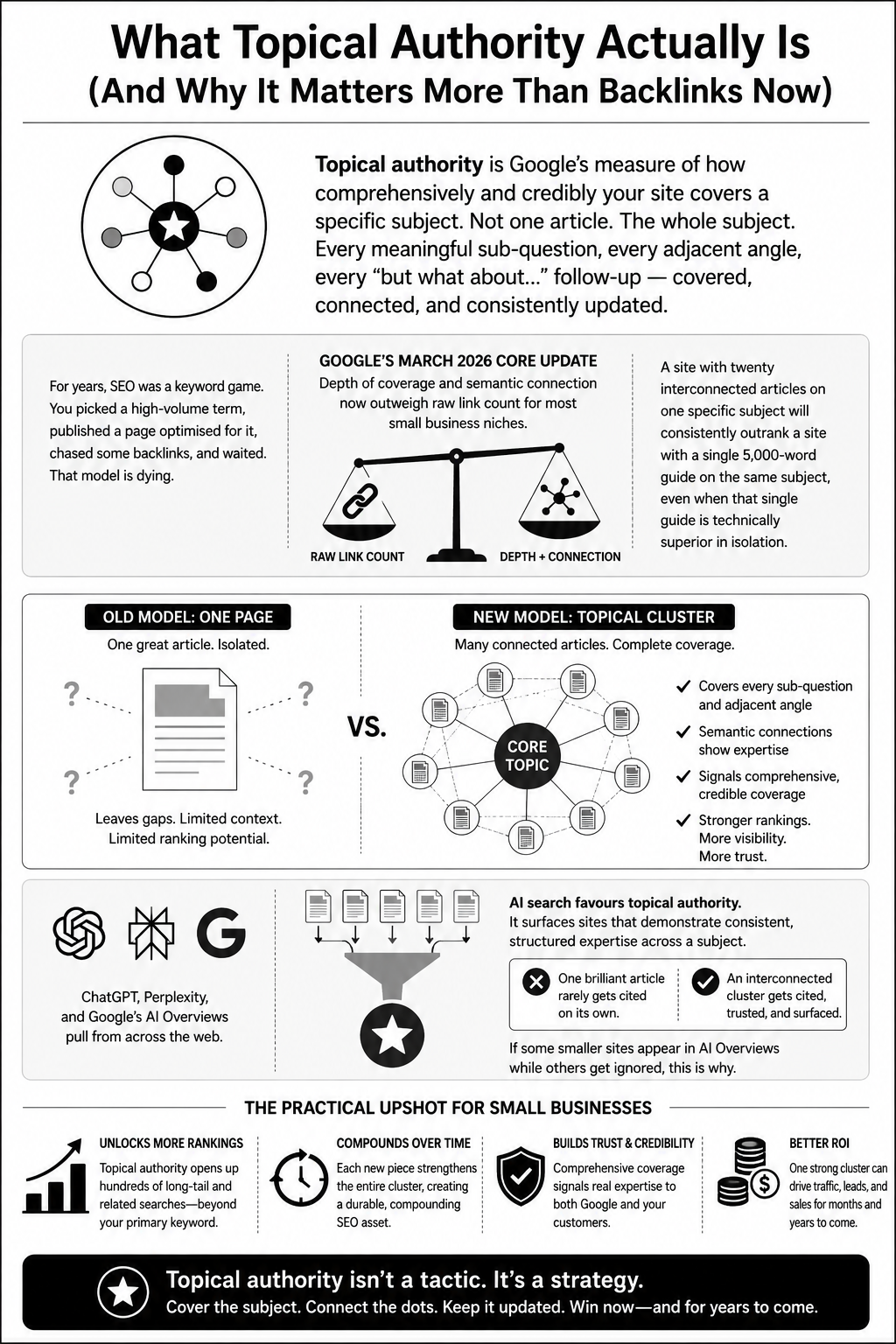
The model that works in 2026 is hub-and-spoke. One comprehensive pillar page on a broad topic, supported by a cluster of focused articles that drill into specific subtopics, all interlinked so search engines and readers can navigate the relationships easily.

A pillar article covers the broad topic comprehensively but not exhaustively. It’s the entry point. It sets up the territory and links outward to the cluster articles that go deeper on each sub-area. Cluster articles each target a specific long-tail question and link back to the pillar, and where it makes sense, to each other. The whole thing functions as a network. Authority compounds across the entire cluster rather than being trapped in one isolated post.

This is where AI earns its keep. Building a topical map manually – the kind of map that identifies every meaningful subtopic in a subject – takes hours of competitor analysis, keyword research, and “people also ask” mining. AI can compress that into a fraction of the time. Hand it your topic, ask it to map the subject space, and you’ll get a starting structure in minutes that would have taken a full day of solo research.

Here’s where it gets nuanced, though. The map AI generates is a starting structure, not the finished article. It will miss the angles only you know, the questions your clients actually ask, the objections nobody’s talking about. That’s the human’s job, and it’s the difference between a cluster that ranks and a cluster that disappears into the noise.

Step-by-Step: How to Brief AI for Topical Depth (Not Topical Noise)

The instinct most people have when they sit down to plan content with AI is to ask for blog post ideas. It’s the wrong starting move and just generates surface-level suggestions disconnected from any deeper structure.

Try this sequence instead.

Step one: define the subject, not the article. Tell AI the exact subject you want to own. Not a keyword. A subject. “I want to be the authority on AI content strategy for solopreneurs in service-based businesses” is a subject. “AI content” is a keyword. The difference matters because subjects have natural boundaries and sub-areas, and AI can map them.

Step two: ask AI to produce a topical map. Get it to list every meaningful sub-area of that subject, then every sub-question within each sub-area. You want depth here. A good map for a tightly defined subject can have fifty to a hundred individual content angles before you start pruning.

Step three: overlay your own knowledge. This is where the human absolutely has to lead. Go through the map and mark every angle where you have specific experience, an opinion that goes against the grain, original data, or a lived example. These become your priority pieces. They’re the ones AI literally cannot produce alone, because the source material isn’t in its training data… it’s in your head.

Step four: design the cluster architecture. Pick the pillar topic. Pick five to seven cluster articles that genuinely support it. Map the internal links between them before writing a single word. Without this step, you’ll end up with articles that orbit each other vaguely without ever connecting.

Step five: brief each piece individually. Generic prompts produce generic content. For each article, write a brief that includes your unique angle, the specific reader you’re writing for, the exact internal links you want included, and a few real examples or stories only you could tell. The brief is the contract, and if your brief is bland, your content will be too. A solid human-first AI content framework makes this part faster than you’d expect.

Where the Human Absolutely Must Lead

There’s a temptation to let AI do all of it. Briefs, drafts, edits, the lot. Resist it.

The parts of content that build topical authority are almost entirely human parts. Original opinion that takes a clear stance is human. Real client examples and lived experience are human. Industry observations that haven’t been published yet are human. The contrarian read on why the dominant advice is wrong is human. Voice (actual recognisable voice) is the most human of all.

When clients come to me frustrated that their AI content isn’t moving the needle, the diagnosis is almost always the same. They’ve outsourced too much to the machine. The AI is doing the thinking and the human is doing the editing, when it needs to work the other way around. AI for scale, structure, and research. Human for opinion, originality, and judgement.

This isn’t a moral position. It’s a strategic point. Google’s E-E-A-T signals are looking for evidence of genuine experience. AI can’t fake that. If your content reads like a tidy synthesis of what’s already on page one of Google, you’ve added nothing to the topic, and the algorithm will treat you accordingly. Building authentic AI brand voice training is the single most important thing you can do before scaling AI-assisted content.

Common Mistakes That Quietly Kill Authority

A few patterns show up repeatedly when small businesses try to build authority with AI and don’t see results.

Publishing volume without coherence is the loudest failure mode. Twenty posts on twenty different angles of “small business marketing” doesn’t build authority on anything. It diffuses the topical signal across too broad a surface. Better to publish six posts that all clearly support one defined subject than twenty that don’t.

Skipping semantic relationships between pieces is the second one. If your pillar article doesn’t link to your cluster articles, and your cluster articles don’t link back to the pillar or to each other, Google can’t see the structure. To the algorithm, you’ve published twenty isolated pages, not a coherent topical cluster.

Treating AI as the writer rather than the assistant is the third. The voice ends up identical across posts because the prompts are identical, the structure is identical, and the personality is missing. Readers feel it before search engines do. Bounce rates go up, time on page drops, return visits stop happening, and Google’s behavioural signals tell the algorithm to deprioritise the site.

Ignoring content freshness is the slow killer. Authority isn’t static. A site that published thirty excellent articles in 2024 and nothing since is less authoritative than one consistently publishing into 2026. The cluster has to be maintained, updated, expanded. This is where AI’s speed becomes genuinely valuable: refreshing existing content and adding new cluster pieces is exactly the kind of work AI can accelerate without compromising quality.

Chasing keywords instead of intent rounds out the list. Optimising heavily for keyword phrases at the expense of actually answering the reader’s question is a leftover instinct from the 2018 SEO playbook. Modern semantic search rewards content that maps to intent, not content that crowbars phrases into headings.

A Realistic Timeline for Seeing Authority Compound

Here’s the truthbomb nobody loves hearing. Topical authority does not happen in six weeks.

Realistic numbers, drawn from sites that have actually executed this strategy: content clusters typically start showing measurable traffic shifts at the three to six month mark, and authority signals compound noticeably over a six to twelve month window. Sites that sustain consistent cluster publishing for twelve months or longer commonly see traffic increases in the 40 to 80% range, with some businesses reporting much higher when they were starting from a low base.

That sounds slow because, by AI-content-mill standards, it is. The trade-off is durability. A site that builds genuine topical authority survives Google core updates. A site built on AI-generated keyword filler does not.

If you’re starting from scratch, the first sixty days are spent on planning and the initial pillar. The next ninety days build out the supporting cluster. From there, monthly publishing maintains momentum, and updates keep the cluster fresh. By month nine to twelve, the compounding effect kicks in, and the cluster starts ranking for keywords you didn’t even directly target, that’s the signal that semantic authority has actually built.

Frequently Asked Questions

How is topical authority different from domain authority? Domain authority is a third-party metric that estimates a site’s overall ranking strength based on backlinks. Topical authority is Google’s internal measure of how comprehensively and credibly your site covers a specific subject. A small site with high topical authority on a narrow subject can outrank a large site with high domain authority but shallow coverage. For small businesses, topical authority is the more achievable and more valuable goal.

Can I use AI to write the entire cluster, or do I need to write it myself? You can use AI for drafting, structuring, and research support, but the original thinking, opinion, and lived examples have to come from you. Pure AI output doesn’t satisfy Google’s E-E-A-T signals or carry the voice that builds reader trust. The most effective workflow is AI-accelerated drafts that you substantially shape, edit, and infuse with your own expertise and personality.

How many cluster articles do I need to support a pillar? Five to seven well-executed cluster articles is enough to start building genuine topical signal for most small business niches. The number matters less than the coherence. Seven articles that all clearly support and link to a single pillar will outperform twenty articles scattered across loosely related topics. Expand the cluster as you identify genuine sub-questions worth answering.

Will AI search engines like ChatGPT and Perplexity cite my cluster content? AI search systems favour sources that demonstrate consistent, structured expertise across a subject. Interconnected cluster content is more likely to be cited than isolated articles for exactly the same reason it ranks better in Google, it shows the AI that your site is a comprehensive resource on that topic. The structural cues that build SEO authority also build citation likelihood in AI Overviews.

What’s the biggest mistake small businesses make when starting a content cluster? Defining the subject too broadly. “Marketing” is not a subject you can own. “Email marketing for solo bookkeepers in Australia” is. The narrower and more specific the subject, the faster topical authority builds. Most small businesses try to compete on subjects that are far too broad for their resources, then wonder why nothing’s moving. Narrowing the focus is almost always the highest-impact fix.

The Bottom Line

Using AI to build topical authority isn’t about producing more content faster. It’s about producing the right content, in the right structure, with the right human signal woven through it. The businesses winning this game in 2026 are using AI to accelerate the parts AI is genuinely good at – research, mapping, structural drafting – and protecting the parts only humans can do, which is everything that makes a piece of content recognisably theirs.

If your AI content has been working harder than you and getting less back, the fix is rarely more AI. Usually it’s better strategy and a clearer human voice underneath. If you’d like a structured way to find out where your current content is leaking authority, the Content Bottleneck Quiz is a fast diagnostic to start with, and the YOU-BOT build is the next step if you’re ready to bake your voice into an AI that actually sounds like you.

Related Posts

How to Use AI to Build Topical Authority: The Smart Content Strategy Most Small Businesses Are Getting Wrong

How to Use AI to Build Topical Authority: The Smart Content Strategy Most Small Businesses Are Getting Wrong

Quick Answer: TLDR Using AI to build topical authority means letting AI handle research, structure, and scale while you lead with original experience, opinion, and lived examples. The strategy that works is pillar-plus-cluster content with strong internal linking:...

read more