
AI Tool Overwhelm Is Real — Here’s What Actually Fixed It

Human-Centred AI Content Strategies for Small Business, Uncategorized

AI tool overwhelm

I once hit peak AI tool overwhelm, and added six tools to my stack in a fortnight

Somewhere between downloading my fifth and sixth AI tool that week and completely forgetting what I was supposed to be doing, I realised I had a problem. AI tool overwhelm, and I had a particularly chronic case of it.

I’d been seduced by the promise. Every day, new tools were landing in my feed, faster, smarter, amazing-er.

So I did what any self-respecting person obsessed with efficiency (and shiny new things) would do: I signed up for them all.

A new AI writing assistant. Another content repurposer. An idea generator. A social media scheduler with built-in AI captions. A transcription tool. And some I honestly can’t remember the name of anymore, which tells you everything.

Before long, I was spending more time playing with tools than creating content. I had six different platforms open on any given Tuesday, and I was copying and pasting between apps like I was playing some kind of video game. And the output? Bland. Disconnected. Could’ve been written by anyone, or, more accurately, by everyone, because it sort of was.

This is what I now call Tool Accumulation Syndrome. It’s not laziness. It’s probably not even a terrible strategy, exactly. It’s what happens when you keep adding inputs without a system to hold them together. You end up with a very expensive, very crowded taskbar and no space to actually think.

What AI tool overwhelm actually costs you

The turning point was embarrassing, as most good wake up calls are.

I was putting together a piece of content for a client – also a good friend – someone with a genuinely brilliant voice, dry humour, strong opinions. I ran it through my usual processes, but this time with some of my new ‘toys’. I sent it off. Ooooof, she replied in about four minutes flat: “This isn’t what I wanted, and nothing like me.”

Ouch. The first time she’d been less than thrilled with my work, and a friend enough to tell it to me straight.

She was right. I’d used five different tools across the process. Each one had smoothed off a little more of her edge, rounded down her specificity, replaced her phrases with serviceable substitutes. By the end, it was sound content. It just wasn’t hers. It was Bot-Wash, and I’d served it up on a silver platter.

That afternoon I deleted about six of those new tools. Kept three. And I started building the only thing that actually matters: a system.

Here’s what the system looks like now. It starts with voice: not a style guide, not a list of adjectives, but actual captured voice. The phrases someone uses when they’re not trying. The rhythm of how they explain something. The specific words they reach for. It comes from extraction, and isn’t created, because the voice already exists. The job is to find it, document it, and protect it from every AI that tries to sand it smooth.

From there, every piece of content passes through the same checkpoint: does this still sound like me? Not “is it grammatically correct” or “does it hit the keywords.” Does. It. Sound. Like. Me. That’s the whole filter. One question. Surprisingly hard to cheat.

The tools I kept are the ones that speed up the parts that don’t require a human: scheduling, formatting, initial drafts that I then pull apart and reassemble. The parts that do require a human? I do those. There’s no shortcut for judgment. There’s no plugin for personality.

Six tools promised the world but made me less productive and more generic. Three tools and a system made me faster and actually useful.

If your AI workflow is currently giving you more to manage than it’s taking off your plate, you don’t need a new tool. You need a clear process and a strong voice at the centre of it.

Say you’re ready to build that system – a voice-first, lean-stack kind – and I’ve got a way to help.

The Humanoid Crew is my membership for small business owners who want to use AI well, not just use a lot of it. Join before May 1 and you get a 30-day bonus sequence designed to help you try, evaluate, and decide on the tools that actually belong in your workflow. One tool a day. Keep it or toss it. No accumulation, or dusty tool collection, just curation.

Here’s where you can read all about it: The Humanoid Crew
What Topical Authority Actually Is

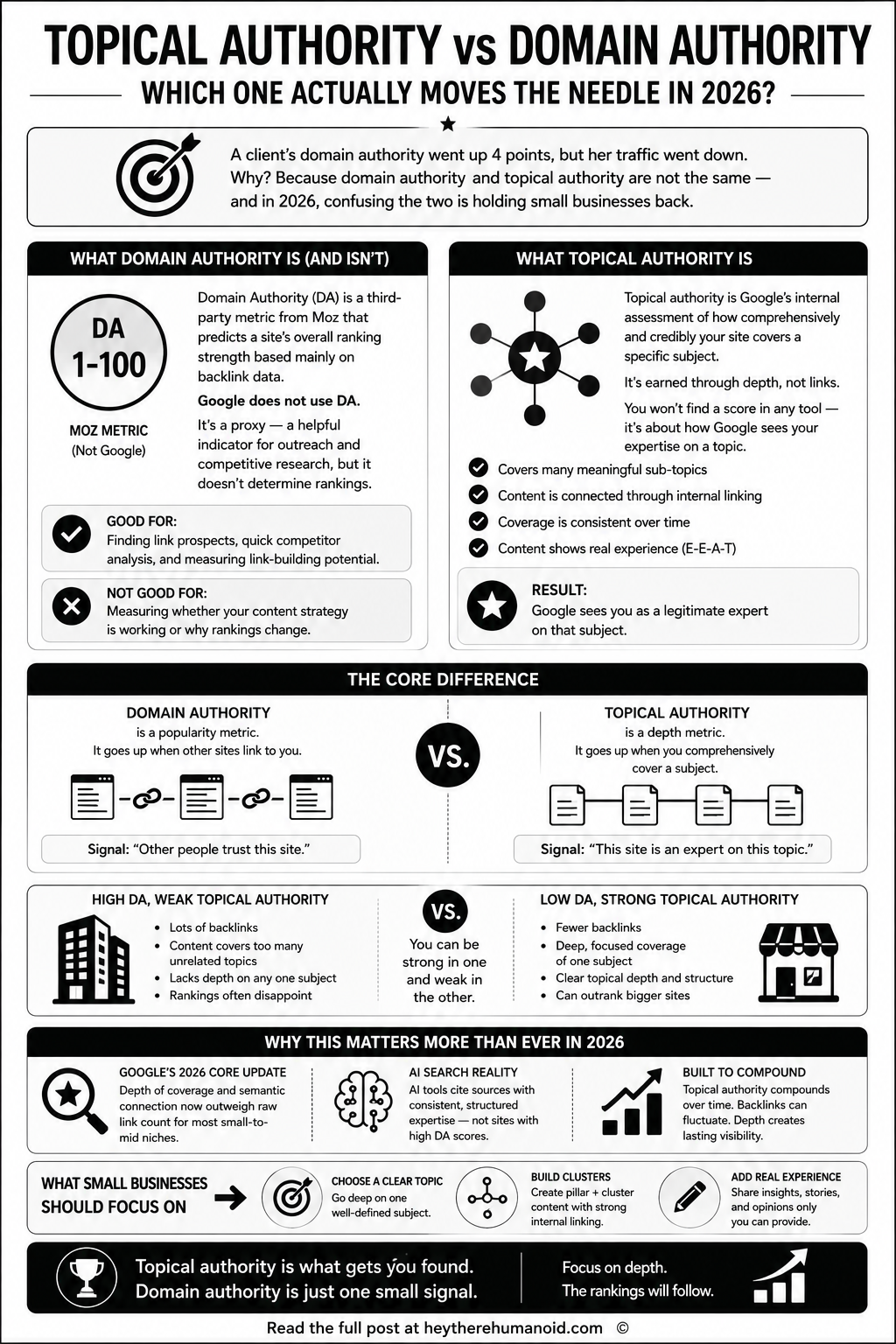
Topical authority is the opposite kind of metric. You won’t find it in a tool dashboard. There’s no single number Moz or Ahrefs can show you. It’s Google’s internal assessment of how comprehensively and credibly your site covers a specific subject.

The mechanism is structural. Google’s quality systems look at how many meaningful sub-areas of a subject your site has covered, how those pieces of content connect to each other through internal linking, whether the coverage is consistent over time, and whether the content shows evidence of genuine experience and expertise. A site that’s published twenty interconnected articles on one specific subject demonstrates topical authority on that subject in a way no amount of backlink building can replicate.

This is what changed. For years, the SEO playbook treated authority as a single sitewide number you could pump up by acquiring links to your homepage. Today, Google treats authority as topic-specific. You can be highly authoritative on one subject and invisible on a neighbouring one, even on the same domain. That’s why niche-focused sites with low DA scores routinely outrank big-brand sites with high DA, the niche site has built genuine depth on a defined subject, and the big-brand site has spread its content too thin to signal authority anywhere in particular.

For small businesses, this is very good news. Building topical authority on a narrow, well-defined subject is something a one-person business can do. Building the kind of backlink profile that moves DA scores in any meaningful way is not. Topical authority is the more accessible game, and right now it’s also the higher-leverage one.

The Core Difference: One Measures Trust, The Other Measures Coverage

The clearest way to think about the difference is this. Domain authority is a popularity metric. Topical authority is a depth metric.

DA goes up when more sites link to yours. The signal Google might infer from those links is “other people trust this site.” It’s a useful signal but it’s a generic one – links don’t tell Google what your site is actually expert about.

Topical authority goes up when your site demonstrably covers a subject comprehensively. The signal Google infers from cluster structure, internal linking, and consistent E-E-A-T markers is “this site is a legitimate expert on this specific topic.” That’s a much more useful signal for ranking purposes, because Google’s job is to surface the most expert source for any given query – not the most generally popular one.

A site can have high DA and weak topical authority. Plenty of established sites are in exactly this position – they accumulated backlinks over years of doing PR and outreach, but their content sprawls across too many subjects to demonstrate depth in any of them. Their DA looks impressive. Their rankings keep slipping. The reverse is also true: a small business site with a DA in the twenties can genuinely outrank a competitor with a DA in the fifties on topic-specific queries, if the smaller site has built coherent topical depth on a narrow subject.

Why This Matters More Now Than It Did Even Twelve Months Ago

Google’s March 2026 Core Update made the topical authority shift explicit in a way it hadn’t been before. The update reinforced a pattern that had been building since the Helpful Content updates of 2022 through 2024: depth and semantic connection between pages now outweigh raw link count for most small-to-mid niches.

There’s a parallel mechanism working through AI search. When ChatGPT, Perplexity, or Google’s AI Overviews need to cite a source, they don’t rank by DA. They favour sources that demonstrate consistent, structured expertise on a topic. Sites with strong topical authority appear in AI citations far more often than higher-DA sites with shallower coverage. If you’ve ever wondered why some smaller sites keep appearing in AI-generated answers, and others don’t, this is the underlying reason.

What this means in practice is that the lever small businesses have access to: building genuine topical depth on a defined subject, is the same lever that drives both traditional SEO ranking and AI search citation. That’s a rare alignment. The strategy that helps you rank in Google is the strategy that gets you cited by AI search engines, and neither of them cares much about your DA score. The full pillar on using AI to build topical authority walks through the cluster-building strategy in greater detail if you want the implementation roadmap.

Where DA Still Has a Legitimate Role

It’s important I’m being fair here. DA isn’t useless. It’s just been promoted to a status it no longer holds.

For outreach prospecting, DA gives you a fast read on whether a backlink from a particular site is likely to carry meaningful weight. For competitive benchmarking, comparing your DA to direct competitors gives you a rough sense of overall site strength. For tracking the trajectory of your own site over twelve to twenty-four month windows, DA can indicate whether your link profile is growing in a healthy direction.

What DA can’t do is tell you whether your content strategy is building authority where it counts. It can’t tell you whether your cluster architecture is sending the right signals to Google. It can’t predict whether you’ll appear in AI Overviews. It can’t diagnose why traffic is flat despite a rising score. For those questions, you need to look at topical signals – coverage depth, internal linking structure, content freshness, and E-E-A-T markers – none of which appear in a DA dashboard.

The honest take is that DA is a useful sidecar metric, not a primary one. Using it as your headline KPI is like judging a restaurant by how many people walked past it last week. Interesting data point. Not the thing that determines whether the food’s any good.

Frequently Asked Questions

Should I stop checking my domain authority?

No, but stop treating it as your primary success metric. Check it quarterly as a directional indicator for overall site health and link profile growth. Pay attention to topical signals: search query coverage, ranking for cluster keywords, AI search citations, and organic traffic patterns on specific topic areas, for the actual measure of whether your content strategy is working.

Is there a tool that measures topical authority directly?

Not in the way DA is measured. There’s no single score, because topical authority is topic-specific rather than sitewide. The closest proxies are tracking your ranking spread across cluster keywords, measuring how many “people also ask” queries your content surfaces for, and monitoring AI search citations. Some platforms market “topical authority scores” but these are estimates, not Google’s actual internal measure.

Can a small business with low DA outrank big brands with high DA?

Yes, and it happens routinely in niche subjects. A small business that has built a tight, coherent content cluster on a narrow subject can outrank larger sites whose coverage is broad but shallow. The smaller site demonstrates topical depth on the specific query, which is what Google’s quality systems reward. This is one of the few areas where small businesses have a genuine structural advantage over enterprise competitors — and most of them aren’t using it.

The Bottom Line

If you’re spending energy chasing a higher domain authority score and ignoring the structure of your content, you’re optimising for the wrong metric. DA is a third-party estimate of a signal that’s no longer the dominant ranking factor for most small business niches. Topical authority is the actual lever, and it’s one of the few SEO investments that a small business can build with content rather than budget.

The good news is that the strategy isn’t complicated, it’s just specific. If you’d like a structured read on where your existing content is helping or hurting your topical signal, the Content Bottleneck Quiz is a fast diagnostic. From there, the work is mapping the cluster, briefing it well, and protecting the parts only you can write.

For the listeners...

Related Posts

How to Use AI to Build Topical Authority: The Smart Content Strategy Most Small Businesses Are Getting Wrong

How to Use AI to Build Topical Authority: The Smart Content Strategy Most Small Businesses Are Getting Wrong

Quick Answer: TLDR Using AI to build topical authority means letting AI handle research, structure, and scale while you lead with original experience, opinion, and lived examples. The strategy that works is pillar-plus-cluster content with strong internal linking:...

read more