

Ever experienced the feeling when reading something… that it’s just a bit off? And that it sounds at best ‘pedestrian’, like a robot could have written it? I know I have! As I’m an avid reader and a professional writer, you can probably imagine my ire when a few months ago I sat down to devour a freshly synced book on my Kindle. Yep, you guessed it – AI generated crap and it was so dull I found it unreadable. Utter horseshit. And aside from feeling just disappointed, I actually felt RIPPED OFF.

Now, with AI writing tools becoming as common as coffee shops on every corner, the world is drowning in content that feels… well, soulless.

Hey There, Humanoid’s mission is GO. “To save language lovers of the world from bleughh robotic buckets of words.” Absolutely not anti-AI, I’m a nerd and love it; but I’m most certainly advocating for AI content that’s human-centric.

Here’s the thing: AI can be brilliant at generating ideas, structuring thoughts, and even pulling together decent sentences. But there’s a massive gap between “decent” and “distinctly you.” The magic happens in that gap, it’s the spot where your voice, personality, and expertise transform blah-blah-blah AI output into content that actually hits the spot with your audience.

Want some tips on how you can master the art of editing AI-generated content to make it authentically yours? Dive on in…

Why Generic AI Content Falls Flat – Let’s Count the Reasons

Before getting into the “how,” let’s talk about the “why.”

Why does unedited AI content often miss the mark?

LLMs (Large Language Models) power AI writing and all are trained on millions of pieces of content from across the web. Essentially they are highly sophisticated pattern-matching machines that predict what word should come next based on what they’ve seen before. This means they operate mathematically at their core, and not from a language loving POV.

It’s why they tend to produce content that’s:

  • Formulaic: AI loves templates and structures it’s seen repeatedly
  • Generic: It aims for broad appeal rather than specific connection
  • Risk-averse: It avoids controversial opinions or strong stances
  • Lacking personality: There’s no personal experience or unique perspective woven in

When using your favourite AI model, you should consider what it gives you as a rough sketch. It will spit out for you a basic outline, but you need to add the colour, texture, and details that make it a masterpiece. Your work of art.

AI Content Editing’s Biggest Rule: Know Your Voice

Before you can knead and massage AI content to sound like you, you must be clear on what “you” actually sounds like. And, this actually isn’t as obvious as it might seem.

Your writing voice is multi-layered and includes:

  • Tone: Are you chatty and informal, or more authoritative and professional?
  • Personality quirks: Do you use humour? Tell stories? Ask rhetorical questions?
  • Vocabulary choices: Do you prefer simple language or more sophisticated terms?
  • Opinion strength: Are you diplomatic or do you take bold stances?
  • Personal touches: Do you share personal anecdotes or stick to general examples?

Straight after reading this article, there’s a job waiting for you. Take a moment to review some of your best-performing content. What patterns do you notice? What about it would make people confident to say, “That sounds exactly like something you’d write”? What you discover are all elements of your brand voice. (Make a note of these to develop a brand voice guide).

Step 1: Add Your Personality from the Word Go

A very common blunder people make when trying to edit AI content, is to try and keep the output’s original structure intact. There’s no need, and to be honest it’s best not to. Instead, use the AI output as raw material that you can reshape completely.

Start the process by reading through the entire piece and asking yourself: “If I were having a conversation with my ideal client about this topic, how would I actually explain it?”

Let’s say AI gives you this opening:
“Content marketing is essential for businesses looking to establish authority and attract customers.”

Pretty vanilla, right?

Your edited version might be:
“Last week, a client told me their biggest frustration: they were creating and sharing content constantly, yet they felt like they were shouting into the void. Does this sound familiar to you?

or even…

Earning the trust customers and getting them to the point of wallet-opening requires more than just posting an occasional blog post or random social media update. If this has been your game plan to date, step aside as strategic content needs to move in and muscle towards the front. Regular, authoritative content is a must for establishing credibility and attracting the right audience to your business.”

See the difference? The second versions both immediately seek connection and create relatability.

Step 2: Bring Some Real Examples and Stories

AI content usually relies on generic examples that could apply to anyone, anywhere. Your job is to swap these out for specific, relevant stories that your audience will actually read and care about.

Instead of just copy-pasting: “For example, a company might see increased engagement when they post regularly.”

Try this instead: “Take Sarah, one of my long-term clients who runs a sustainable fashion brand. She’s gone from around 12 likes per instagram post to consistent engagement in the hundreds. And not by posting more, but by sharing the story behind each piece she designs. I’m sure your business has plenty of stories, so be more like Sarah.”

Real examples do three things:

  1. They prove you know what you’re talking about
  2. They help readers visualise success
  3. The make abstract concepts concrete, even if the details are tiny and specific (=credibility)

Step 3: Replace AI’s Sit-on-the-Fence Words with Confident Language

AI loves hedge words like “might,” “could,” “potentially,” and “in some cases.” These words don’t lock you into false claims, but they do make your content feel wishy-washy and uncertain.

Your audience doesn’t want maybes, they want guidance from someone who knows their stuff. And if you want to be seen as a go-to business in your industry, you’re going to have to stand for something, not fence sit.

Change:
“This strategy could potentially help you see better results.”

To something like:
“This strategy will transform your results. It works and I know it does, because I’ve seen it succeed for dozens of clients.”

The key is backing up your confidence with experience and evidence.

Step 4: Add Your Unique Insights and Hot Takes

Here’s where you should really make AI content your own: add insights that only you could provide. This might be:

  • A contrarian viewpoint based on your experience (stir some shit up, I dare you!)
  • A connection between two seemingly unrelated concepts
  • A prediction about where your industry is heading
  • A common misconception you frequently encounter

For instance, if you’re writing about social media marketing, you might add:
“Everyone talks about posting consistently, but here’s what they don’t tell you: consistency without strategy is just pissing in the wind. I’d rather see you post twice a week with intention than daily posts that mean little don’t serve your goals.”

Step 5: Adjust the Emotional Temperature

AI tends to be emotionally neutral, but your best content probably has feeling behind it. Are you frustrated by a common industry practice? Excited about a new development? Empathetic to your audience’s struggles?

Don’t be afraid to show emotion in your writing. It’s what makes people feel connected to you rather than just informed by you. And it’s genuinely something robots haven’t got the knack of yet.

Step 6: Tighten Your Transitions and Flow

AI generated content often feels choppy or disjointed. As you edit, pay attention to how ideas flow from one to the next.

Ask yourself:

  • Does each paragraph logically follow the previous one?
  • Are there smooth bridges between different sections?
  • Would a reader get lost if they skimmed through?

Good transitions aren’t just about stumble-free reading. Well written transitions take your reader on a journey that feels intentional and well-planned. Smooth writing feels thoughtful and AI output can really miss the mark here.

Step 7: End with Your Authentic Call-to-Action

AI often generates generic calls-to-action like “Contact us to learn more” or “Visit our website for additional resources.” Yeah, yeah, whatever.

Your CTA should reflect your personality and make a specific promise. Instead of asking people to “get in touch,” tell them exactly what they’ll get when they do:

“Ready to transform your AI-generated content into something that sounds unmistakably you? Book a call with me, because making your unique voice be seen is exactly what I do best.”

Here’s the Edit That Makes the Biggest Difference

The number one difference between content that converts and content that gets skipped over is the answer to this question: does it sound like a real person wrote it for other real people?

If the answer is a floor-stomping yes, then you’re good. If it’s a no, rework it until it does. Your edit has to go beyond removing pesky em-dashes, swapping z’s for s’s and deleting the tired old AI phrasing (you know, in the fast-paced business world..)

Your endpoint needs to showcase your expertise, personality, and unique perspective. So take it from something that could have been written by anyone to a piece of writing that could only have been created by you.

And the best part? The more you practice this editing process, the better you’ll get at prompting AI to give you drafts that are closer to your voice from the start. AI can handle the heavy lifting of structure and research, and you can focus on what you do best: being authentically you.

Your Voice Still Rules the Roost

AI can generate endless amounts of content. And it is being used to do so. Seeing it everywhere, right?

Before long there’s going to be clear winners in the content game, those who write with the efficiency of AI, blended seamlessly with the irreplaceable value of human insight and personality.

Ready to transform your AI-generated content into something that sounds unmistakably you? Well, that’s something I can certainly help with. Book a strategy session, or grab a Prompt Playbook, just start using AI as a bloody good tool and not your replacement.
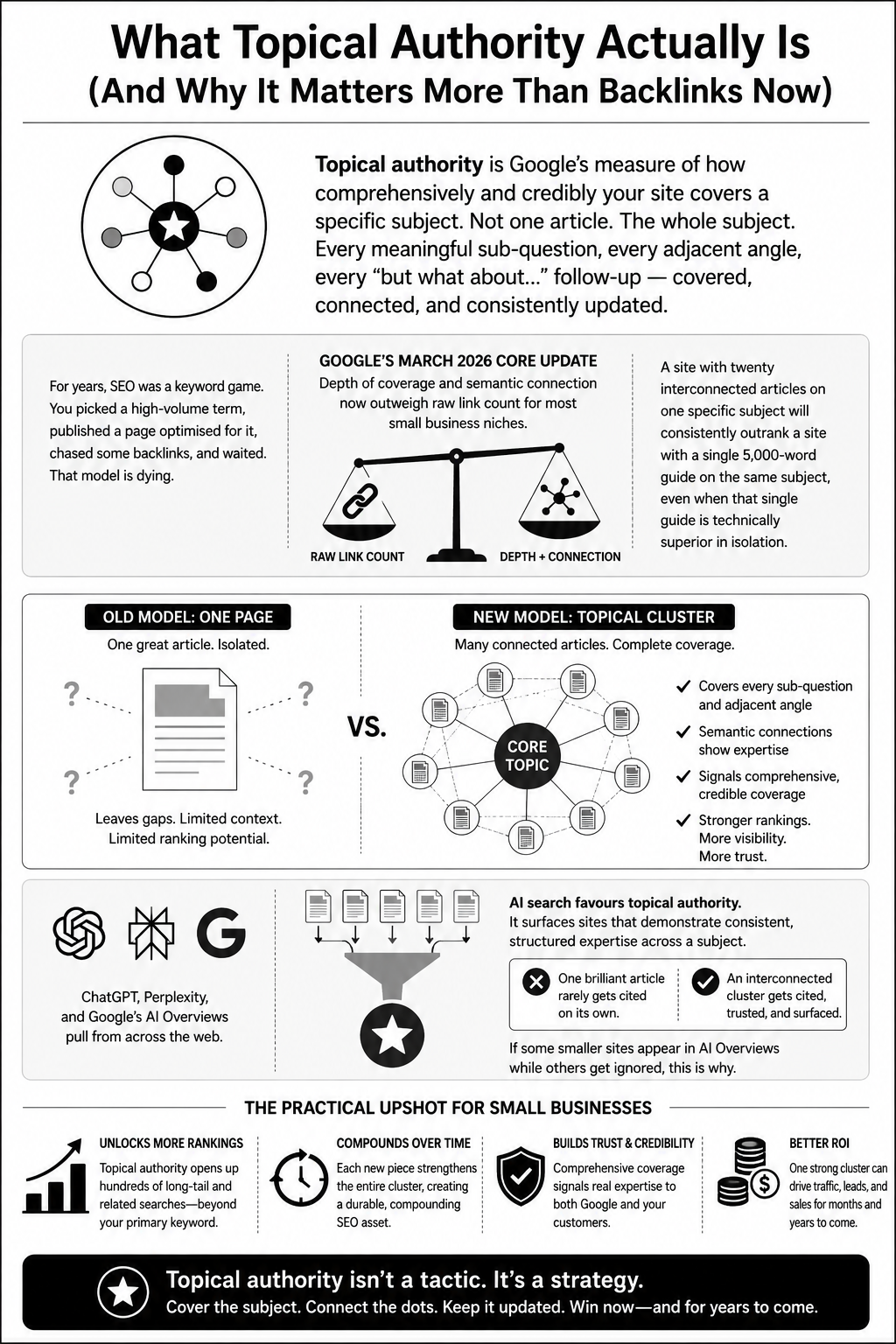

Want to Know Why Most AI-Generated Content Fails to Build Authority?

The same tools that could help you build topical authority faster than ever are also the tools producing most of the content that’s quietly killing it.

The pattern goes like this. A small business owner reads that they need to publish more. They open ChatGPT, ask for ten blog post ideas on their topic, pick the three that look easiest, generate them all in a single afternoon, and publish them across the next fortnight. The posts are technically fine. Grammar’s correct. Word count’s respectable. There are even some bullet points and a closing sentence that says “in conclusion.”

Google’s response? A polite nothing.

This is the part most AI content marketing advice skips over. AI-generated content fails to build authority for three specific reasons, and none of them are about the AI itself. They’re about how it’s being used. The first failure is topical noise instead of topical depth. Ten posts on vaguely related topics is noise. Ten posts that interconnect around one defined subject is depth. Most AI workflows produce noise because nobody’s mapping the subject first.

The second failure is missing E-E-A-T signals. Google’s quality systems look for evidence of experience, expertise, authoritativeness, and trustworthiness. AI on its own provides exactly none of these. It can rephrase what already exists. It can’t tell Google about the time you lost a client because of a hallucinated case study, or what you learned the month you tripled your retainer rates and lost half your roster. Those signals only come from you.

The third failure is structural sameness. When everyone in a niche uses similar tools with similar prompts, the output starts looking eerily uniform. Same headings, same sentence rhythm, same vague “in today’s fast-paced digital landscape” energy. Google’s systems are increasingly good at detecting this pattern, and so are readers. If you want to understand why this happens at the prompt level, there’s a missing ingredient in most AI prompts that’s worth knowing before you go any further.

The Framework: Pillar + Cluster + Internal Linking, Done With AI as Your Research Partner

The model that works in 2026 is hub-and-spoke. One comprehensive pillar page on a broad topic, supported by a cluster of focused articles that drill into specific subtopics, all interlinked so search engines and readers can navigate the relationships easily.

A pillar article covers the broad topic comprehensively but not exhaustively. It’s the entry point. It sets up the territory and links outward to the cluster articles that go deeper on each sub-area. Cluster articles each target a specific long-tail question and link back to the pillar, and where it makes sense, to each other. The whole thing functions as a network. Authority compounds across the entire cluster rather than being trapped in one isolated post.

This is where AI earns its keep. Building a topical map manually – the kind of map that identifies every meaningful subtopic in a subject – takes hours of competitor analysis, keyword research, and “people also ask” mining. AI can compress that into a fraction of the time. Hand it your topic, ask it to map the subject space, and you’ll get a starting structure in minutes that would have taken a full day of solo research.

Here’s where it gets nuanced, though. The map AI generates is a starting structure, not the finished article. It will miss the angles only you know, the questions your clients actually ask, the objections nobody’s talking about. That’s the human’s job, and it’s the difference between a cluster that ranks and a cluster that disappears into the noise.

Step-by-Step: How to Brief AI for Topical Depth (Not Topical Noise)

The instinct most people have when they sit down to plan content with AI is to ask for blog post ideas. It’s the wrong starting move and just generates surface-level suggestions disconnected from any deeper structure.

Try this sequence instead.

Step one: define the subject, not the article. Tell AI the exact subject you want to own. Not a keyword. A subject. “I want to be the authority on AI content strategy for solopreneurs in service-based businesses” is a subject. “AI content” is a keyword. The difference matters because subjects have natural boundaries and sub-areas, and AI can map them.

Step two: ask AI to produce a topical map. Get it to list every meaningful sub-area of that subject, then every sub-question within each sub-area. You want depth here. A good map for a tightly defined subject can have fifty to a hundred individual content angles before you start pruning.

Step three: overlay your own knowledge. This is where the human absolutely has to lead. Go through the map and mark every angle where you have specific experience, an opinion that goes against the grain, original data, or a lived example. These become your priority pieces. They’re the ones AI literally cannot produce alone, because the source material isn’t in its training data… it’s in your head.

Step four: design the cluster architecture. Pick the pillar topic. Pick five to seven cluster articles that genuinely support it. Map the internal links between them before writing a single word. Without this step, you’ll end up with articles that orbit each other vaguely without ever connecting.

Step five: brief each piece individually. Generic prompts produce generic content. For each article, write a brief that includes your unique angle, the specific reader you’re writing for, the exact internal links you want included, and a few real examples or stories only you could tell. The brief is the contract, and if your brief is bland, your content will be too. A solid human-first AI content framework makes this part faster than you’d expect.

Where the Human Absolutely Must Lead

There’s a temptation to let AI do all of it. Briefs, drafts, edits, the lot. Resist it.

The parts of content that build topical authority are almost entirely human parts. Original opinion that takes a clear stance is human. Real client examples and lived experience are human. Industry observations that haven’t been published yet are human. The contrarian read on why the dominant advice is wrong is human. Voice (actual recognisable voice) is the most human of all.

When clients come to me frustrated that their AI content isn’t moving the needle, the diagnosis is almost always the same. They’ve outsourced too much to the machine. The AI is doing the thinking and the human is doing the editing, when it needs to work the other way around. AI for scale, structure, and research. Human for opinion, originality, and judgement.

This isn’t a moral position. It’s a strategic point. Google’s E-E-A-T signals are looking for evidence of genuine experience. AI can’t fake that. If your content reads like a tidy synthesis of what’s already on page one of Google, you’ve added nothing to the topic, and the algorithm will treat you accordingly. Building authentic AI brand voice training is the single most important thing you can do before scaling AI-assisted content.

Common Mistakes That Quietly Kill Authority

A few patterns show up repeatedly when small businesses try to build authority with AI and don’t see results.

Publishing volume without coherence is the loudest failure mode. Twenty posts on twenty different angles of “small business marketing” doesn’t build authority on anything. It diffuses the topical signal across too broad a surface. Better to publish six posts that all clearly support one defined subject than twenty that don’t.

Skipping semantic relationships between pieces is the second one. If your pillar article doesn’t link to your cluster articles, and your cluster articles don’t link back to the pillar or to each other, Google can’t see the structure. To the algorithm, you’ve published twenty isolated pages, not a coherent topical cluster.

Treating AI as the writer rather than the assistant is the third. The voice ends up identical across posts because the prompts are identical, the structure is identical, and the personality is missing. Readers feel it before search engines do. Bounce rates go up, time on page drops, return visits stop happening, and Google’s behavioural signals tell the algorithm to deprioritise the site.

Ignoring content freshness is the slow killer. Authority isn’t static. A site that published thirty excellent articles in 2024 and nothing since is less authoritative than one consistently publishing into 2026. The cluster has to be maintained, updated, expanded. This is where AI’s speed becomes genuinely valuable: refreshing existing content and adding new cluster pieces is exactly the kind of work AI can accelerate without compromising quality.

Chasing keywords instead of intent rounds out the list. Optimising heavily for keyword phrases at the expense of actually answering the reader’s question is a leftover instinct from the 2018 SEO playbook. Modern semantic search rewards content that maps to intent, not content that crowbars phrases into headings.

A Realistic Timeline for Seeing Authority Compound

Here’s the truthbomb nobody loves hearing. Topical authority does not happen in six weeks.

Realistic numbers, drawn from sites that have actually executed this strategy: content clusters typically start showing measurable traffic shifts at the three to six month mark, and authority signals compound noticeably over a six to twelve month window. Sites that sustain consistent cluster publishing for twelve months or longer commonly see traffic increases in the 40 to 80% range, with some businesses reporting much higher when they were starting from a low base.

That sounds slow because, by AI-content-mill standards, it is. The trade-off is durability. A site that builds genuine topical authority survives Google core updates. A site built on AI-generated keyword filler does not.

If you’re starting from scratch, the first sixty days are spent on planning and the initial pillar. The next ninety days build out the supporting cluster. From there, monthly publishing maintains momentum, and updates keep the cluster fresh. By month nine to twelve, the compounding effect kicks in, and the cluster starts ranking for keywords you didn’t even directly target, that’s the signal that semantic authority has actually built.

Frequently Asked Questions

How is topical authority different from domain authority? Domain authority is a third-party metric that estimates a site’s overall ranking strength based on backlinks. Topical authority is Google’s internal measure of how comprehensively and credibly your site covers a specific subject. A small site with high topical authority on a narrow subject can outrank a large site with high domain authority but shallow coverage. For small businesses, topical authority is the more achievable and more valuable goal.

Can I use AI to write the entire cluster, or do I need to write it myself? You can use AI for drafting, structuring, and research support, but the original thinking, opinion, and lived examples have to come from you. Pure AI output doesn’t satisfy Google’s E-E-A-T signals or carry the voice that builds reader trust. The most effective workflow is AI-accelerated drafts that you substantially shape, edit, and infuse with your own expertise and personality.

How many cluster articles do I need to support a pillar? Five to seven well-executed cluster articles is enough to start building genuine topical signal for most small business niches. The number matters less than the coherence. Seven articles that all clearly support and link to a single pillar will outperform twenty articles scattered across loosely related topics. Expand the cluster as you identify genuine sub-questions worth answering.

Will AI search engines like ChatGPT and Perplexity cite my cluster content? AI search systems favour sources that demonstrate consistent, structured expertise across a subject. Interconnected cluster content is more likely to be cited than isolated articles for exactly the same reason it ranks better in Google, it shows the AI that your site is a comprehensive resource on that topic. The structural cues that build SEO authority also build citation likelihood in AI Overviews.

What’s the biggest mistake small businesses make when starting a content cluster? Defining the subject too broadly. “Marketing” is not a subject you can own. “Email marketing for solo bookkeepers in Australia” is. The narrower and more specific the subject, the faster topical authority builds. Most small businesses try to compete on subjects that are far too broad for their resources, then wonder why nothing’s moving. Narrowing the focus is almost always the highest-impact fix.

The Bottom Line

Using AI to build topical authority isn’t about producing more content faster. It’s about producing the right content, in the right structure, with the right human signal woven through it. The businesses winning this game in 2026 are using AI to accelerate the parts AI is genuinely good at – research, mapping, structural drafting – and protecting the parts only humans can do, which is everything that makes a piece of content recognisably theirs.

If your AI content has been working harder than you and getting less back, the fix is rarely more AI. Usually it’s better strategy and a clearer human voice underneath. If you’d like a structured way to find out where your current content is leaking authority, the Content Bottleneck Quiz is a fast diagnostic to start with, and the YOU-BOT build is the next step if you’re ready to bake your voice into an AI that actually sounds like you.

Related Posts

How to Use AI to Build Topical Authority: The Smart Content Strategy Most Small Businesses Are Getting Wrong

How to Use AI to Build Topical Authority: The Smart Content Strategy Most Small Businesses Are Getting Wrong

Quick Answer: TLDR Using AI to build topical authority means letting AI handle research, structure, and scale while you lead with original experience, opinion, and lived examples. The strategy that works is pillar-plus-cluster content with strong internal linking:...

read more