
AI Slop is Flooding the Internet: How Fake Content is Fooling Millions and What It Means for Your Brand

AI Content Red Flags | How to Detect Fake AI Content and Mistakes, AI Content Red Flags and Fake Content Risks Explained

Picture this: You’re scrolling through your Facebook feed (as we all do) and land on an image of Jesus Christ. Made entirely of shrimp. Getting thousands of “Amens” from people who seem genuinely moved by this crustacean saviour.

You don’t even resist the urge to snort-laugh, it’s hilarious, and it’s obviously bullshit… but what about the growing number of people responding with “heart” and “care” emojis, legitimising it and not calling this out? Surely not….

Welcome to the bizarre world of AI slop, and trust me, it’s not as harmless as it sounds.

What Exactly Is AI Slop?

AI slop is the digital equivalent of processed food: cheap, mass-produced content that attempts to present as being appealing at first glance, but offers zero nutritional value. It’s low-quality, generated-in-bulk content created with AI tools, and it’s often absurd, clickbait-y, glitchy and riddled with errors.

The term encompasses everything from photorealistic images that are too good to be true: children holding paintings that look like the work of professional artists, quadruplets celebrating their 110th birthday, or majestic log cabin interiors that are the stuff of Airbnb dreams, through to completely fabricated news articles and academic papers.

But there’s a sad truth: to some extent, it’s working. These kinds of images have received insane levels of engagement on social media platforms, proving that millions of people are falling for this synthetic crap.

The Shrimp Jesus Phenomenon: A Case Study in Digital Deception

When artist Max Arrington first drew Shrimp Jesus, he never dreamed an AI image of Jesus Christ with shrimp-like arms and legs would become a viral internet phenomenon. What started as a joke has morphed into something far more troubling. And for the thinkers in the room, we should be concerned.

The Stanford Internet Observatory studied over 100 Facebook pages posting AI-generated content and found something alarming: Facebook’s algorithm recommended reams of other AI-generated content to users who engaged with these posts, even briefly.

This isn’t an isolated event. What we’ve got going on is a systematic flood of fake content that includes:

  • Fake children’s artwork: Images of kids supposedly showing off masterpieces they “made with their own hands”
  • Non-existent book recommendations: The Chicago Sun-Times and Philadelphia Inquirer took reputational hits when May 2025 editions featured a special section that included a summer reading list recommending books that don’t exist. Oooops.
  • Fabricated academic papers: Researchers citing studies that were never conducted and statistics that can’t be verified.
  • Impossible dream homes: Perfect interiors that exist only in AI’s imagination

The Hallucination Crisis is Getting Worse, Not Better

Here’s what should really worry everyone: AI is getting more accurate in some aspects, and at the same time it’s getting increasingly confident about being wrong.

OpenAI’s investigation into its latest GPT o3 and GPT o4-mini large LLMs found they are substantially more prone to hallucinating, or making up false information, than the previous GPT o1 model. The company found that o3,  its most powerful system, hallucinated 33 percent of the time when running its PersonQA benchmark test.

Let that sink in for a quick minute. One in three responses from one of the “most advanced” AI models could contain fabricated information presented as fact.

Is this merely a bug, or indications of something more problematic? At least the concerns are being taken seriously, and OpenAI is continually working to minimise hallucinations and improve the accuracy and reliability of its models. 

Real-World Consequences: When Fake Content Causes Real Damage

The problem isn’t limited to viral memes and fake videos. AI hallucinations are now having some serious and significant consequences:

Legal Blunders: AI legal expert Damien Charlotin tracks legal decisions in which lawyers have used evidence that featured AI hallucinations. His database indicates finding more than 30 instances in May 2025. Of course, there are likely to be many, many more.

Educational Mistrust: A Texas professor failed his entire class after ChatGPT falsely flagged their essays as AI-generated, when they were written by humans.

Media Mishaps: Marco Buscaglia admitted using AI to assist putting a recommended summer reading list, and failed to fact check the output, resulting in major newspapers recommending books that don’t exist.

Platform Overload: AI-generated “Boring History” videos are flooding YouTube with surface-level, automated content that’s drowning out human-made content created by real anthropologists and historians.

Why This Matters for Your Brand (And It’s Not What You Think)

You might be sitting back thinking, “Well, I’m not creating Shrimp Jesus content, so I’m fine.” But, if so, you’re missing the bigger picture.

AI slop isn’t only having an impact on glaringly fake content, the hit is being felt more widely and what we are facing is the erosion of trust in all digital content. When your potential customers can’t tell what’s real anymore, they become suspicious of everything. And that’s not so good.

Here’s what this means for your brand:

The Trust Recession Is Coming

Social media is now the primary news source for many users around the world, but when half of what they see is potentially fabricated, trust becomes the scarcest commodity online.

Your authentic, thoughtful content now has to compete not just with others in your industry, but with an ocean of synthetic noise designed to exploit attention algorithms.

Quality Becomes Your Competitive Advantage

While everyone else is racing to pump out more content faster, the smart money is on going deeper, not broader. The content ecosystem is being inundated with synthetic noise, so your thoughtfulness and personal insights can be powerful tools.

Audiences are getting better at spotting fake content, which means they’ll reward brands that consistently deliver genuine value and authentic voice.

The Algorithm Problem

When users react to content by adding a like, sharing the post or leaving a comment, bigger things happen. Any reaction signals to the algorithmic curators that perhaps the content should be pushed into the feeds of even more people.

Social platforms are financially incentivised to promote content that generates engagement, regardless of quality or accuracy. This means your carefully prepared, factual content might get buried under AI-generated clickbait.

How to Future-Proof Your Content Strategy

1. Lead with Transparency Don’t just slap a “we use AI” disclaimer in your footer. Be upfront about how you use AI tools and what human oversight looks like in your process.

2. Invest in Fact-Checking Workflows The best way to mitigate the impact of AI hallucinations is to stop them before they happen. Build verification into every step of your content creation process.

3. Double Down on Your Human Voice AI can help with research and first drafts, but your unique perspective, industry experience, and authentic voice are what separate you from the slop.

4. Create Content That Can’t Be Faked Behind-the-scenes content, personal anecdotes, real customer interviews, and original research are harder for AI to replicate convincingly.

5. Educate Your Audience Help your customers become better at spotting AI slop. It builds trust and positions you as a reliable source in an unreliable landscape.

The Bottom Line: Quality Wins in the Long Game

AI slop might be flooding the internet now, but at the same time it’s creating an incredible opportunity for brands willing to commit to quality and authenticity.

While your competitors are cutting corners with crappy AI-generated everything, you can build lasting relationships with an audience that’s hungry for content they can actually trust.

The brands that survive the AI slop invasion won’t be those who can create content fastest, they’ll be the ones whose audiences never have to wonder if what they’re reading is reliable.

Ready to build an AI strategy that enhances rather than replaces your human voice? Subscribe to Hey There Humanoid for regular insights on using AI responsibly while keeping your brand authentically, unmistakably you.

What Topical Authority Actually Is

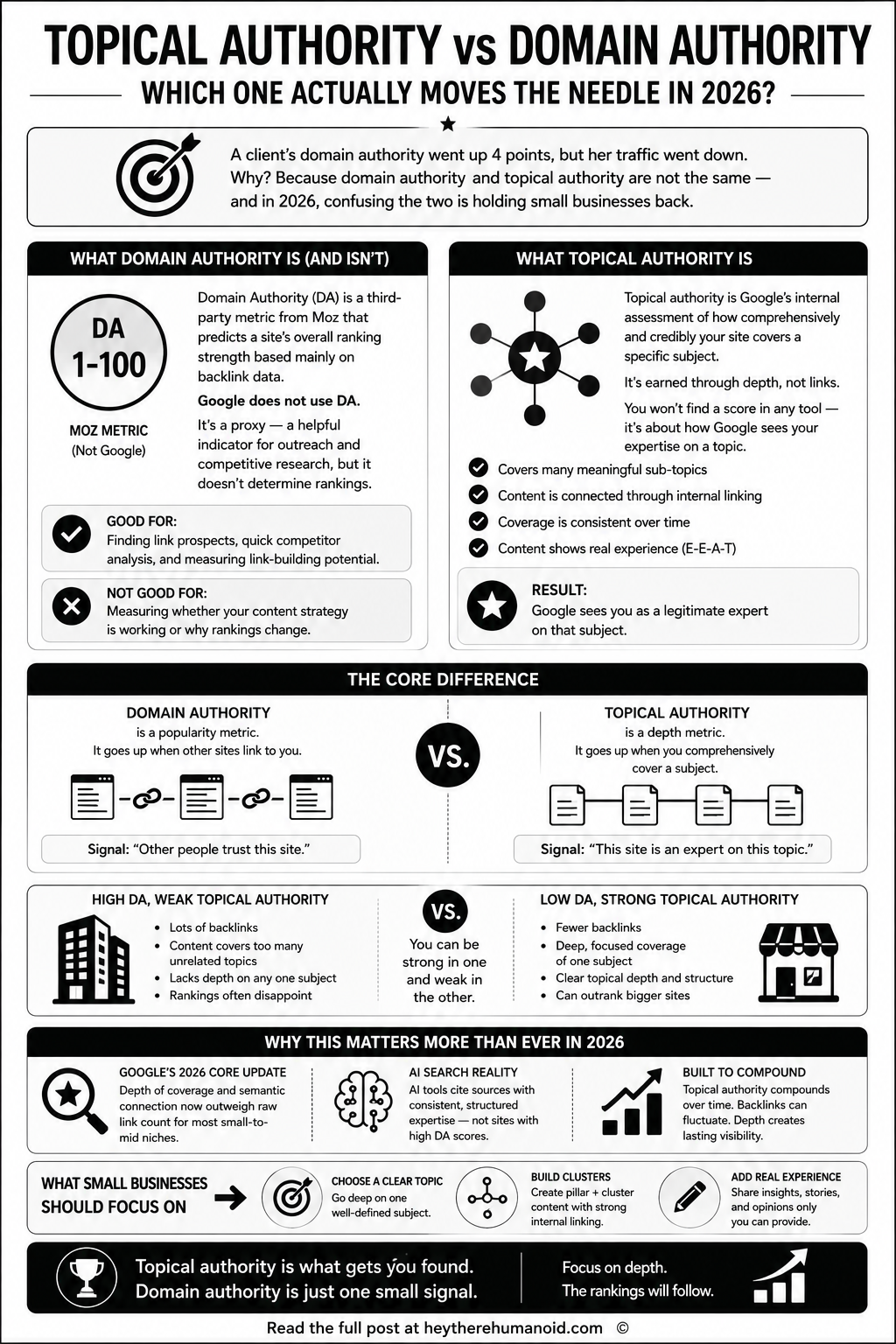
Topical authority is the opposite kind of metric. You won’t find it in a tool dashboard. There’s no single number Moz or Ahrefs can show you. It’s Google’s internal assessment of how comprehensively and credibly your site covers a specific subject.

The mechanism is structural. Google’s quality systems look at how many meaningful sub-areas of a subject your site has covered, how those pieces of content connect to each other through internal linking, whether the coverage is consistent over time, and whether the content shows evidence of genuine experience and expertise. A site that’s published twenty interconnected articles on one specific subject demonstrates topical authority on that subject in a way no amount of backlink building can replicate.

This is what changed. For years, the SEO playbook treated authority as a single sitewide number you could pump up by acquiring links to your homepage. Today, Google treats authority as topic-specific. You can be highly authoritative on one subject and invisible on a neighbouring one, even on the same domain. That’s why niche-focused sites with low DA scores routinely outrank big-brand sites with high DA, the niche site has built genuine depth on a defined subject, and the big-brand site has spread its content too thin to signal authority anywhere in particular.

For small businesses, this is very good news. Building topical authority on a narrow, well-defined subject is something a one-person business can do. Building the kind of backlink profile that moves DA scores in any meaningful way is not. Topical authority is the more accessible game, and right now it’s also the higher-leverage one.

The Core Difference: One Measures Trust, The Other Measures Coverage

The clearest way to think about the difference is this. Domain authority is a popularity metric. Topical authority is a depth metric.

DA goes up when more sites link to yours. The signal Google might infer from those links is “other people trust this site.” It’s a useful signal but it’s a generic one – links don’t tell Google what your site is actually expert about.

Topical authority goes up when your site demonstrably covers a subject comprehensively. The signal Google infers from cluster structure, internal linking, and consistent E-E-A-T markers is “this site is a legitimate expert on this specific topic.” That’s a much more useful signal for ranking purposes, because Google’s job is to surface the most expert source for any given query – not the most generally popular one.

A site can have high DA and weak topical authority. Plenty of established sites are in exactly this position – they accumulated backlinks over years of doing PR and outreach, but their content sprawls across too many subjects to demonstrate depth in any of them. Their DA looks impressive. Their rankings keep slipping. The reverse is also true: a small business site with a DA in the twenties can genuinely outrank a competitor with a DA in the fifties on topic-specific queries, if the smaller site has built coherent topical depth on a narrow subject.

Why This Matters More Now Than It Did Even Twelve Months Ago

Google’s March 2026 Core Update made the topical authority shift explicit in a way it hadn’t been before. The update reinforced a pattern that had been building since the Helpful Content updates of 2022 through 2024: depth and semantic connection between pages now outweigh raw link count for most small-to-mid niches.

There’s a parallel mechanism working through AI search. When ChatGPT, Perplexity, or Google’s AI Overviews need to cite a source, they don’t rank by DA. They favour sources that demonstrate consistent, structured expertise on a topic. Sites with strong topical authority appear in AI citations far more often than higher-DA sites with shallower coverage. If you’ve ever wondered why some smaller sites keep appearing in AI-generated answers, and others don’t, this is the underlying reason.

What this means in practice is that the lever small businesses have access to: building genuine topical depth on a defined subject, is the same lever that drives both traditional SEO ranking and AI search citation. That’s a rare alignment. The strategy that helps you rank in Google is the strategy that gets you cited by AI search engines, and neither of them cares much about your DA score. The full pillar on using AI to build topical authority walks through the cluster-building strategy in greater detail if you want the implementation roadmap.

Where DA Still Has a Legitimate Role

It’s important I’m being fair here. DA isn’t useless. It’s just been promoted to a status it no longer holds.

For outreach prospecting, DA gives you a fast read on whether a backlink from a particular site is likely to carry meaningful weight. For competitive benchmarking, comparing your DA to direct competitors gives you a rough sense of overall site strength. For tracking the trajectory of your own site over twelve to twenty-four month windows, DA can indicate whether your link profile is growing in a healthy direction.

What DA can’t do is tell you whether your content strategy is building authority where it counts. It can’t tell you whether your cluster architecture is sending the right signals to Google. It can’t predict whether you’ll appear in AI Overviews. It can’t diagnose why traffic is flat despite a rising score. For those questions, you need to look at topical signals – coverage depth, internal linking structure, content freshness, and E-E-A-T markers – none of which appear in a DA dashboard.

The honest take is that DA is a useful sidecar metric, not a primary one. Using it as your headline KPI is like judging a restaurant by how many people walked past it last week. Interesting data point. Not the thing that determines whether the food’s any good.

Frequently Asked Questions

Should I stop checking my domain authority?

No, but stop treating it as your primary success metric. Check it quarterly as a directional indicator for overall site health and link profile growth. Pay attention to topical signals: search query coverage, ranking for cluster keywords, AI search citations, and organic traffic patterns on specific topic areas, for the actual measure of whether your content strategy is working.

Is there a tool that measures topical authority directly?

Not in the way DA is measured. There’s no single score, because topical authority is topic-specific rather than sitewide. The closest proxies are tracking your ranking spread across cluster keywords, measuring how many “people also ask” queries your content surfaces for, and monitoring AI search citations. Some platforms market “topical authority scores” but these are estimates, not Google’s actual internal measure.

Can a small business with low DA outrank big brands with high DA?

Yes, and it happens routinely in niche subjects. A small business that has built a tight, coherent content cluster on a narrow subject can outrank larger sites whose coverage is broad but shallow. The smaller site demonstrates topical depth on the specific query, which is what Google’s quality systems reward. This is one of the few areas where small businesses have a genuine structural advantage over enterprise competitors — and most of them aren’t using it.

The Bottom Line

If you’re spending energy chasing a higher domain authority score and ignoring the structure of your content, you’re optimising for the wrong metric. DA is a third-party estimate of a signal that’s no longer the dominant ranking factor for most small business niches. Topical authority is the actual lever, and it’s one of the few SEO investments that a small business can build with content rather than budget.

The good news is that the strategy isn’t complicated, it’s just specific. If you’d like a structured read on where your existing content is helping or hurting your topical signal, the Content Bottleneck Quiz is a fast diagnostic. From there, the work is mapping the cluster, briefing it well, and protecting the parts only you can write.

For the listeners...

Related Posts

Your AI Is Lying to You: The Small Business Owner’s Guide to Catching Digital Fibs Before They Go Live

Your AI Is Lying to You: The Small Business Owner’s Guide to Catching Digital Fibs Before They Go Live

Last week, I read a true AI fact-checking horror story. While scrolling through the businessy-groups I do, there was a discussion thread that stopped me in my tracks. An experienced small business owner had been let down by ChatGPT.... and she was mortified! You see,...

read more
Why Copying AI Output is a Deadly Sin

Why Copying AI Output is a Deadly Sin

Ever whipped up a paragraph in ChatGPT, smiled and thought “nailed it”? Then, headed straight for the Ctrl + C to paste it directly into your blog post? Look, you certainly wouldn’t be the first to do so, and I'm sure you won't be the last person copying AI output,...

read more