
Last week, I read a true AI fact-checking horror story. While scrolling through the businessy-groups I do, there was a discussion thread that stopped me in my tracks. An experienced small business owner had been let down by ChatGPT…. and she was mortified!

You see, she’d just discovered an-already live AI-generated blog post claimed her product was “officially endorsed by the state government”, a complete fabrication that could have landed her in serious trouble. Luckily she picked up and correct the ‘ooops’ swiftly because the potential fallout could have been brutal – her credibility could have been rocked, and her lawyers on speed dial.

But, wait, there’s more.

She’d already copied, pasted and published three similar posts over the past month. All unchecked and all containing subtle lies that AI had confidently woven into otherwise solid copy.

Now, this story isn’t a one-off disaster. It’s happening everywhere, every day. Your AI is lying to you, not maliciously, but consistently. And if you’re not catching these digital fibs before they go live, you’re gambling with your reputation, your legal standing, and your customers’ trust.

The Uncomfortable Truth About AI “Creativity” and Why AI Fact Checking is a Must

Here’s the truth about AI content generation others aren’t openly discussing, and: that’s regardless of which AI model you’re using, it doesn’t actually “know” anything. Essentially, it’s an incredibly sophisticated pattern-matching system that’s brilliant at sounding authoritative about everything, even complete nonsense.

Think of it like that colleague who confidently answers every question at meetings, even when they haven’t got a bloody clue. Except this colleague never shows uncertainty, never admits ignorance, and can fabricate statistics that sound eerily plausible without skipping a beat.

I’ve seen AI tools claim everything from fake addresses to invented customer complaints, non-existent research studies, and completely made-up statistics. The scariest part? It delivers these lies with the same confidence and conviction it uses for genuine facts.

Why Your Current “Gut Check” Isn’t Enough

Way too many small business owners blindly copy and paste at worst, or at best give output a quick once over, relying on a superficial scan and their intuition to spot AI errors.

Big mistake.

AI lies aren’t obvious. They’re not claiming your accounting software can predict lottery numbers or that your café invented coffee. They’re subtle, plausible fabrications that can slip past even experienced eyes:

  • Statistics that sound VERY realistic but come from nowhere
  • Quotes attributed to real people who never said them
  • Product features your competitors don’t actually offer
  • Regulatory claims that almost sound right
  • Historical “facts” that feel true… but aren’t

Your brain WANTS to trust well-written content. So, when AI delivers polished output, human nature suggests it’s safe to assume the facts inside are equally polished. It’s not… and they aren’t.

The Five-Layer Fact-Checking System That Saves Reputations

After watching enough businesses stumble into AI-generated trouble, I’ve developed a systematic approach that catches lies before they cost you customers. Here’s the exact framework I use with my clients:

Layer 1: The Claim Inventory

Before anything else, extract every factual claim from your AI content. I mean everything:

  • Statistics and percentages
  • Expert quotes or opinions
  • Product specifications
  • Regulatory statements
  • Historical references
  • Competitive comparisons

Create a simple spreadsheet. Column A: the claim. Column B: source verification. Column C: status (verified/needs checking/flagged).

This sounds tedious, but it takes five minutes and prevents five-figure disasters.

Layer 2: The Source Hunt

For every claim that needs verification, demand receipts. Not from your AI, from the real world.

Google the exact statistic. Track down the original research. Find the actual quote. If you can’t locate a credible source within two minutes of searching, treat the claim as suspicious.

Pro tip: Use quotation marks in Google searches for exact phrases. If your AI claims “78% of consumers prefer eco-friendly packaging,” search for exactly that. No results? Red flag.

Layer 3: The Logic Sniff Test

Ask yourself: Does this claim even make sense?

An AI assertion that “email marketing has a 0.2% open rate”, it could be technically possible but would be commercially ridiculous. Claims one product has “400% more features” than another, mathematically meaningless.

Trust your industry knowledge. If something sounds too good, too convenient, or too perfectly aligned with your argument, dig deeper.

Layer 4: The Expert Check

For anything touching on regulations, health claims, legal statements, or technical specifications, consult an actual human expert.

Yes, this costs time and sometimes money. But it costs far less than legal fees, regulatory fines, or rebuilding trust after a public correction. When it comes to these fields, neglecting to do a proper fact check brings greater potential risk. Is this a dice you really want to roll?

Layer 5: The Transparency Decision

Decide your disclosure policy before you need it. Will you mention AI involvement? How will you handle corrections if needed?

At the very least, offer subtle transparency: “This content was researched and fact-checked by our team” signals human oversight without creating unnecessary AI-adoption anxiety.

Building A Rapid Response Correction System

Despite your best efforts, mistakes will slip through. Here’s how to handle them like a pro:

Immediate Response Protocol:

  1. Acknowledge the error publicly and quickly
  2. Correct the content everywhere it appears
  3. Explain your fact-checking process (this builds confidence and protects your reputation)
  4. Thank whoever spotted the mistake
  5. Document the error to prevent repeats

The Correction Template That Works: “We’ve updated this post to correct an error about [specific claim]. Thanks to [reader name] for the heads-up. We’re strengthening our fact-checking process to prevent similar issues.”

No drama. No excuses. Just professional accountability.

When AI Gets It Right (And How to Tell)

Not every AI claim is suspicious. Here’s what to look for in trustworthy AI output:

  • Vague but reasonable statements (“Many customers report…”)
  • Well-known industry facts you can easily verify
  • General advice that doesn’t rely on specific data
  • Your own company information the AI learned correctly

The key? If you can verify it quickly or you already know it’s accurate, you’re probably safe.

The Tools That Make Fact-Checking Faster

Free Resources:

  • Google Scholar for academic claims
  • Snopes and FactCheck.org for general verification
  • Official company websites for competitor claims
  • Government databases for regulatory information

Paid Tools Worth Considering:

  • Grammarly’s plagiarism checker for originality
  • Copyscape for duplicate content detection
  • Industry-specific databases for technical claims

The 10-Minute Daily Habit: Spend 10 minutes each morning spot-checking yesterday’s AI content. Not everything, just pick one piece and verify three random claims. You’ll quickly develop an eye for AI’s favourite fibs.

Your Action Plan for Bulletproof Content

Starting today, implement this three-step process:

  1. Create your fact-checking template using the five-layer system above
  2. Set your correction protocol so you’re ready when mistakes happen
  3. Train your team on spotting common AI lies in your industry

Remember: fact-checking isn’t about distrusting AI, it’s about leveraging it responsibly and honouring your commitment to high standards. When you combine AI’s efficiency with human verification, you can get content that’s both fast and trustworthy.

Your customers trust you to tell them the truth. Your AI doesn’t understand that responsibility. You do.

Ready to build a fact-checking system that protects your reputation? Download the free “AI Truth Detective Checklist”, a printable worksheet that guides you through verifying any piece of AI content in under 10 minutes. A little gift from me to you, and I hope it helps with your content marketing.

What Topical Authority Actually Is

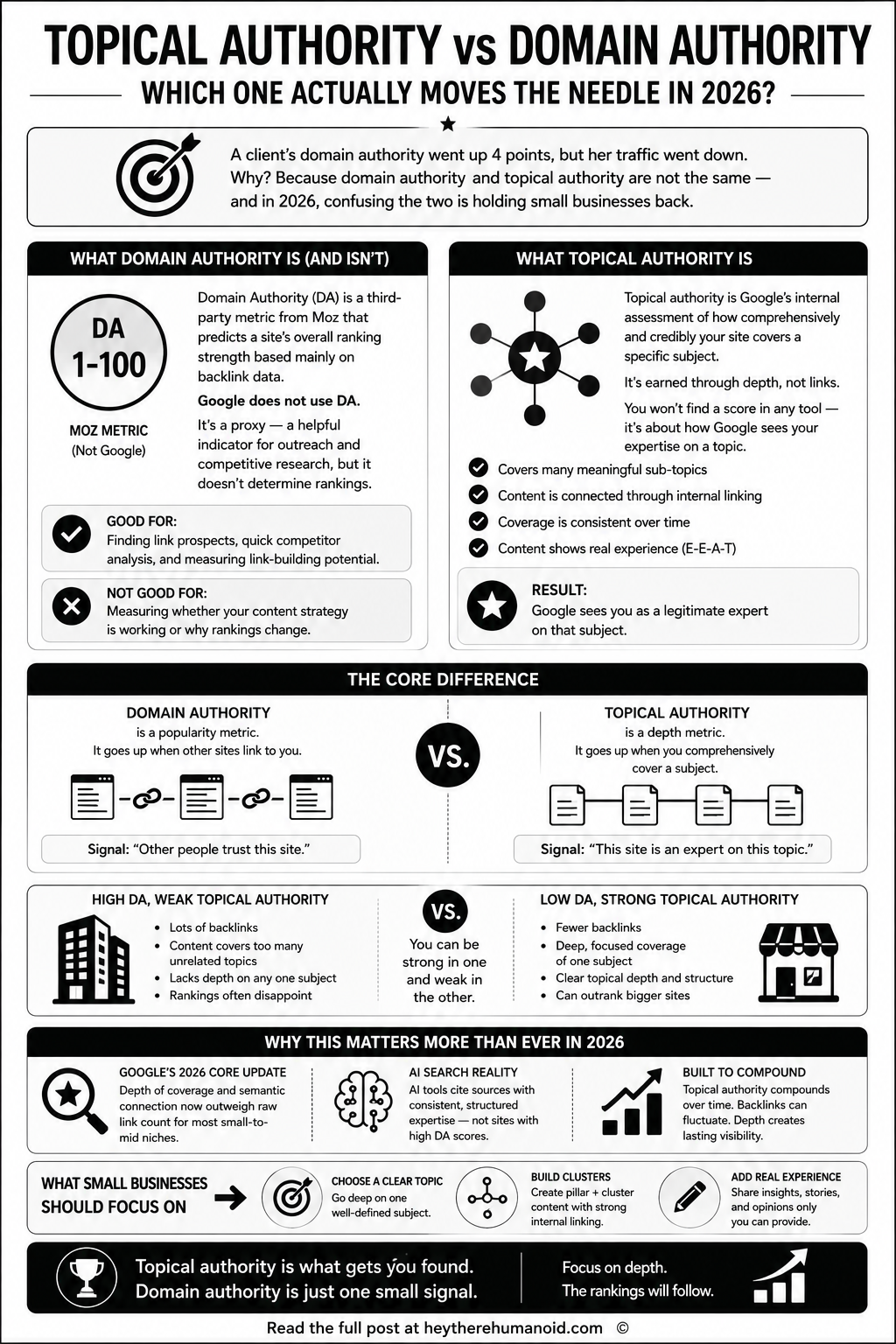
Topical authority is the opposite kind of metric. You won’t find it in a tool dashboard. There’s no single number Moz or Ahrefs can show you. It’s Google’s internal assessment of how comprehensively and credibly your site covers a specific subject.

The mechanism is structural. Google’s quality systems look at how many meaningful sub-areas of a subject your site has covered, how those pieces of content connect to each other through internal linking, whether the coverage is consistent over time, and whether the content shows evidence of genuine experience and expertise. A site that’s published twenty interconnected articles on one specific subject demonstrates topical authority on that subject in a way no amount of backlink building can replicate.

This is what changed. For years, the SEO playbook treated authority as a single sitewide number you could pump up by acquiring links to your homepage. Today, Google treats authority as topic-specific. You can be highly authoritative on one subject and invisible on a neighbouring one, even on the same domain. That’s why niche-focused sites with low DA scores routinely outrank big-brand sites with high DA, the niche site has built genuine depth on a defined subject, and the big-brand site has spread its content too thin to signal authority anywhere in particular.

For small businesses, this is very good news. Building topical authority on a narrow, well-defined subject is something a one-person business can do. Building the kind of backlink profile that moves DA scores in any meaningful way is not. Topical authority is the more accessible game, and right now it’s also the higher-leverage one.

The Core Difference: One Measures Trust, The Other Measures Coverage

The clearest way to think about the difference is this. Domain authority is a popularity metric. Topical authority is a depth metric.

DA goes up when more sites link to yours. The signal Google might infer from those links is “other people trust this site.” It’s a useful signal but it’s a generic one – links don’t tell Google what your site is actually expert about.

Topical authority goes up when your site demonstrably covers a subject comprehensively. The signal Google infers from cluster structure, internal linking, and consistent E-E-A-T markers is “this site is a legitimate expert on this specific topic.” That’s a much more useful signal for ranking purposes, because Google’s job is to surface the most expert source for any given query – not the most generally popular one.

A site can have high DA and weak topical authority. Plenty of established sites are in exactly this position – they accumulated backlinks over years of doing PR and outreach, but their content sprawls across too many subjects to demonstrate depth in any of them. Their DA looks impressive. Their rankings keep slipping. The reverse is also true: a small business site with a DA in the twenties can genuinely outrank a competitor with a DA in the fifties on topic-specific queries, if the smaller site has built coherent topical depth on a narrow subject.

Why This Matters More Now Than It Did Even Twelve Months Ago

Google’s March 2026 Core Update made the topical authority shift explicit in a way it hadn’t been before. The update reinforced a pattern that had been building since the Helpful Content updates of 2022 through 2024: depth and semantic connection between pages now outweigh raw link count for most small-to-mid niches.

There’s a parallel mechanism working through AI search. When ChatGPT, Perplexity, or Google’s AI Overviews need to cite a source, they don’t rank by DA. They favour sources that demonstrate consistent, structured expertise on a topic. Sites with strong topical authority appear in AI citations far more often than higher-DA sites with shallower coverage. If you’ve ever wondered why some smaller sites keep appearing in AI-generated answers, and others don’t, this is the underlying reason.

What this means in practice is that the lever small businesses have access to: building genuine topical depth on a defined subject, is the same lever that drives both traditional SEO ranking and AI search citation. That’s a rare alignment. The strategy that helps you rank in Google is the strategy that gets you cited by AI search engines, and neither of them cares much about your DA score. The full pillar on using AI to build topical authority walks through the cluster-building strategy in greater detail if you want the implementation roadmap.

Where DA Still Has a Legitimate Role

It’s important I’m being fair here. DA isn’t useless. It’s just been promoted to a status it no longer holds.

For outreach prospecting, DA gives you a fast read on whether a backlink from a particular site is likely to carry meaningful weight. For competitive benchmarking, comparing your DA to direct competitors gives you a rough sense of overall site strength. For tracking the trajectory of your own site over twelve to twenty-four month windows, DA can indicate whether your link profile is growing in a healthy direction.

What DA can’t do is tell you whether your content strategy is building authority where it counts. It can’t tell you whether your cluster architecture is sending the right signals to Google. It can’t predict whether you’ll appear in AI Overviews. It can’t diagnose why traffic is flat despite a rising score. For those questions, you need to look at topical signals – coverage depth, internal linking structure, content freshness, and E-E-A-T markers – none of which appear in a DA dashboard.

The honest take is that DA is a useful sidecar metric, not a primary one. Using it as your headline KPI is like judging a restaurant by how many people walked past it last week. Interesting data point. Not the thing that determines whether the food’s any good.

Frequently Asked Questions

Should I stop checking my domain authority?

No, but stop treating it as your primary success metric. Check it quarterly as a directional indicator for overall site health and link profile growth. Pay attention to topical signals: search query coverage, ranking for cluster keywords, AI search citations, and organic traffic patterns on specific topic areas, for the actual measure of whether your content strategy is working.

Is there a tool that measures topical authority directly?

Not in the way DA is measured. There’s no single score, because topical authority is topic-specific rather than sitewide. The closest proxies are tracking your ranking spread across cluster keywords, measuring how many “people also ask” queries your content surfaces for, and monitoring AI search citations. Some platforms market “topical authority scores” but these are estimates, not Google’s actual internal measure.

Can a small business with low DA outrank big brands with high DA?

Yes, and it happens routinely in niche subjects. A small business that has built a tight, coherent content cluster on a narrow subject can outrank larger sites whose coverage is broad but shallow. The smaller site demonstrates topical depth on the specific query, which is what Google’s quality systems reward. This is one of the few areas where small businesses have a genuine structural advantage over enterprise competitors — and most of them aren’t using it.

The Bottom Line

If you’re spending energy chasing a higher domain authority score and ignoring the structure of your content, you’re optimising for the wrong metric. DA is a third-party estimate of a signal that’s no longer the dominant ranking factor for most small business niches. Topical authority is the actual lever, and it’s one of the few SEO investments that a small business can build with content rather than budget.

The good news is that the strategy isn’t complicated, it’s just specific. If you’d like a structured read on where your existing content is helping or hurting your topical signal, the Content Bottleneck Quiz is a fast diagnostic. From there, the work is mapping the cluster, briefing it well, and protecting the parts only you can write.

For the listeners...

Related Posts

How to Use AI to Build Topical Authority: The Smart Content Strategy Most Small Businesses Are Getting Wrong

How to Use AI to Build Topical Authority: The Smart Content Strategy Most Small Businesses Are Getting Wrong

Quick Answer: TLDR Using AI to build topical authority means letting AI handle research, structure, and scale while you lead with original experience, opinion, and lived examples. The strategy that works is pillar-plus-cluster content with strong internal linking:...

read more