

AI content repurposing is the bomb… when it’s done right.

You’ve written a solid blog post. Now you want to turn it into social content, an email, maybe a LinkedIn post. So you ask ChatGPT to “repurpose this into a LinkedIn post” and what you get back sounds like a corporate announcement written by someone who’s never met you.

That’s not an AI problem. That’s an input problem.

Too many people treat AI like a vending machine, just press B4…. and while it sounds easy they’ll get the same snack as everyone else. They feed it vague instructions (“make this sound professional”) and then bitterly wonder why the output tastes like LinkedIn thought leader garbage. AI content repurposing will of course produce bland output when you give it generic instructions.

Plenty of mainstream advice tells you to “just add your brand voice” after the fact. That’s backwards. Voice extraction needs to happens before you generate anything, not during cleanup.

The one thing to nail before you touch any AI tool

Define what your voice actually is.

Not what you think it should be. Not “professional but approachable.” What does your voice sound like when you’re explaining something to a mate over coffee? When you’re annoyed on behalf of your clients? When you’re calling out something that frustrates you?

Collect real examples:

  • Emails you’ve sent where people replied “this is so you”
  • Voice notes where you weren’t performing
  • Rants in your Notes app
  • Client conversations where you felt like yourself

Your brand voice already exists in your unfiltered communication. Stop inventing it from scratch. Extract it from what’s already there. This is voice extraction over voice creation, and it’s the difference between AI that sounds like you and AI that sounds like a template.

How to train AI on your actual voice (not generic “professional”)

Once you’ve collected examples of your real voice, you need to teach the AI what patterns matter.

Create a voice reference document that includes:

  • 3-5 writing samples that sound unmistakably like you
  • Sentence rhythm notes (short and punchy vs long and winding)
  • Words and phrases you actually use
  • Words and phrases you’d never use
  • Your stance on common topics in your industry

Then, when you’re ready to repurpose content with AI, you feed this into your prompt alongside the original piece. Not as an afterthought. As the foundation.

Here’s what doesn’t work: “Make this sound like me.” The AI has no idea who you are.

Here’s what does: “Using the voice patterns in the attached reference doc, rewrite this blog intro for LinkedIn. Keep the same contractions, sentence variety, and directness. Avoid corporate jargon.”

Specificity is your friend. Vague prompts get vague outputs. Vague is not your friend.

A prompt framework that stops bland content before it starts

Every effective content repurposing strategy follows this structure:

  1. Context: What’s the original format and goal?
  2. Voice anchor: Reference your voice doc or paste 2-3 example sentences
  3. New format requirements: Length, platform, tone shift if needed
  4. Constraints: What to avoid, what must stay
  5. Output instruction: Specific format (bullet points, paragraphs, script)

Example: “This is a 1200-word blog post about AI prompting [paste excerpt]. My voice is conversational, direct, uses contractions, and avoids corporate speak [paste voice sample]. Turn this into a 150-word LinkedIn post that leads with a bold statement, not a question. Avoid phrases like ‘unlock potential’ or ‘digital landscape.’ Write in second person.”

That’s a prompt that does the work upfront so you’re not spending 20 minutes editing robot speak later.

Turn one core piece into eight formats without copy-paste energy

Once you’ve nailed your prompt, repurposing becomes a system, not a slog.

One blog post becomes:

  • Email newsletter (reframe the hook, tighten the body, softer CTA)
  • LinkedIn carousel (pull key points, add visual hierarchy)
  • Instagram caption (lead with the strongest insight, trim to 300 words)
  • Twitter thread (break into punchy statements, one idea per tweet)
  • Short video script (conversational intro, three main points, question to close)
  • Email sequence (split into problem/solution/action across 3 emails)

The AI handles structure and length adjustments. You handle voice calibration and platform-specific tweaks. Batch your prompts, generate all formats in one session, then edit with fresh eyes.

This is how you scale content creation without burning out or sacrificing authenticity.

When to let AI run vs when to grab the wheel back

AI is brilliant at structure, terrible at nuance.

Let it handle:

  • Format conversions (blog to email, post to thread)
  • Length adjustments (long to short, short to expanded)
  • Idea generation (10 ways to angle this topic)
  • First draft speed (get words on the page fast)

Grab the wheel for:

  • Opening hooks (AI defaults to questions, you need statements)
  • Personal stories or examples (AI invents, you lived it)
  • Controversial stances (AI plays it safe, you don’t)
  • Final polish (sentence rhythm, word choice, personality injection)

The editing checklist that saves your brand: Read it aloud. If you wouldn’t say it, rewrite it. If it sounds like it came from anyone else, bin it. If a sentence has no job, cut it.

AI is a tool, not your replacement. It gives your words speed. You give your words soul. That combination is how you maintain brand voice while scaling output without the Sunday night content scramble.

Sound like yourself. On purpose. Every time.

Can AI maintain my writing style when repurposing content?

Yes, but only if you train it properly. AI doesn’t inherently know your voice. You need to provide specific voice samples, clear constraints, and detailed prompts. Generic instructions produce generic outputs. When you give AI concrete examples of your actual communication patterns, it can replicate tone, rhythm, and word choice effectively.

How do I repurpose content without sounding generic?

Start with voice extraction, not voice creation. Collect examples of your real communication (emails, voice notes, unfiltered writing), then create a voice reference document. Use this in every prompt alongside specific format requirements and constraints. The key is detailed and purposeful prompting upfront, not endless editing afterward.

What’s the best way to scale content creation with AI?

Build a repeatable system: define your voice clearly, create prompt templates for each format (email, social, blog), batch your content generation in focused sessions, then edit for personality and platform-specific nuances. Let AI handle structure and speed; you handle voice calibration and authenticity checks.

Can AI content sound authentic?

Only when you make it. AI outputs are only as good as your inputs. Vague prompts produce bland content. Detailed prompts with voice anchors, specific constraints, and clear format requirements produce content that reflects your actual communication style. Authenticity requires human oversight and final polish.

What Topical Authority Actually Is

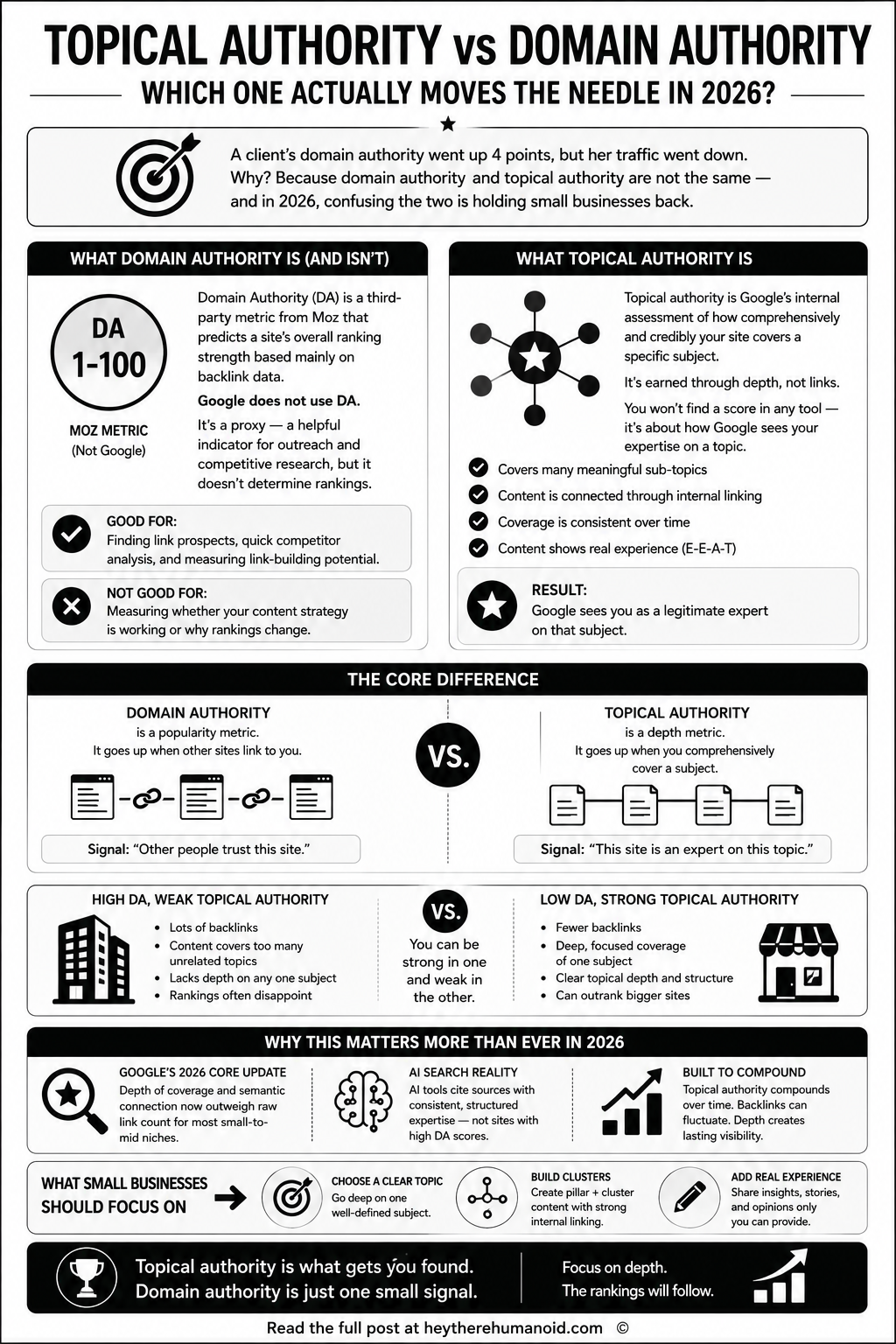
Topical authority is the opposite kind of metric. You won’t find it in a tool dashboard. There’s no single number Moz or Ahrefs can show you. It’s Google’s internal assessment of how comprehensively and credibly your site covers a specific subject.

The mechanism is structural. Google’s quality systems look at how many meaningful sub-areas of a subject your site has covered, how those pieces of content connect to each other through internal linking, whether the coverage is consistent over time, and whether the content shows evidence of genuine experience and expertise. A site that’s published twenty interconnected articles on one specific subject demonstrates topical authority on that subject in a way no amount of backlink building can replicate.

This is what changed. For years, the SEO playbook treated authority as a single sitewide number you could pump up by acquiring links to your homepage. Today, Google treats authority as topic-specific. You can be highly authoritative on one subject and invisible on a neighbouring one, even on the same domain. That’s why niche-focused sites with low DA scores routinely outrank big-brand sites with high DA, the niche site has built genuine depth on a defined subject, and the big-brand site has spread its content too thin to signal authority anywhere in particular.

For small businesses, this is very good news. Building topical authority on a narrow, well-defined subject is something a one-person business can do. Building the kind of backlink profile that moves DA scores in any meaningful way is not. Topical authority is the more accessible game, and right now it’s also the higher-leverage one.

The Core Difference: One Measures Trust, The Other Measures Coverage

The clearest way to think about the difference is this. Domain authority is a popularity metric. Topical authority is a depth metric.

DA goes up when more sites link to yours. The signal Google might infer from those links is “other people trust this site.” It’s a useful signal but it’s a generic one – links don’t tell Google what your site is actually expert about.

Topical authority goes up when your site demonstrably covers a subject comprehensively. The signal Google infers from cluster structure, internal linking, and consistent E-E-A-T markers is “this site is a legitimate expert on this specific topic.” That’s a much more useful signal for ranking purposes, because Google’s job is to surface the most expert source for any given query – not the most generally popular one.

A site can have high DA and weak topical authority. Plenty of established sites are in exactly this position – they accumulated backlinks over years of doing PR and outreach, but their content sprawls across too many subjects to demonstrate depth in any of them. Their DA looks impressive. Their rankings keep slipping. The reverse is also true: a small business site with a DA in the twenties can genuinely outrank a competitor with a DA in the fifties on topic-specific queries, if the smaller site has built coherent topical depth on a narrow subject.

Why This Matters More Now Than It Did Even Twelve Months Ago

Google’s March 2026 Core Update made the topical authority shift explicit in a way it hadn’t been before. The update reinforced a pattern that had been building since the Helpful Content updates of 2022 through 2024: depth and semantic connection between pages now outweigh raw link count for most small-to-mid niches.

There’s a parallel mechanism working through AI search. When ChatGPT, Perplexity, or Google’s AI Overviews need to cite a source, they don’t rank by DA. They favour sources that demonstrate consistent, structured expertise on a topic. Sites with strong topical authority appear in AI citations far more often than higher-DA sites with shallower coverage. If you’ve ever wondered why some smaller sites keep appearing in AI-generated answers, and others don’t, this is the underlying reason.

What this means in practice is that the lever small businesses have access to: building genuine topical depth on a defined subject, is the same lever that drives both traditional SEO ranking and AI search citation. That’s a rare alignment. The strategy that helps you rank in Google is the strategy that gets you cited by AI search engines, and neither of them cares much about your DA score. The full pillar on using AI to build topical authority walks through the cluster-building strategy in greater detail if you want the implementation roadmap.

Where DA Still Has a Legitimate Role

It’s important I’m being fair here. DA isn’t useless. It’s just been promoted to a status it no longer holds.

For outreach prospecting, DA gives you a fast read on whether a backlink from a particular site is likely to carry meaningful weight. For competitive benchmarking, comparing your DA to direct competitors gives you a rough sense of overall site strength. For tracking the trajectory of your own site over twelve to twenty-four month windows, DA can indicate whether your link profile is growing in a healthy direction.

What DA can’t do is tell you whether your content strategy is building authority where it counts. It can’t tell you whether your cluster architecture is sending the right signals to Google. It can’t predict whether you’ll appear in AI Overviews. It can’t diagnose why traffic is flat despite a rising score. For those questions, you need to look at topical signals – coverage depth, internal linking structure, content freshness, and E-E-A-T markers – none of which appear in a DA dashboard.

The honest take is that DA is a useful sidecar metric, not a primary one. Using it as your headline KPI is like judging a restaurant by how many people walked past it last week. Interesting data point. Not the thing that determines whether the food’s any good.

Frequently Asked Questions

Should I stop checking my domain authority?

No, but stop treating it as your primary success metric. Check it quarterly as a directional indicator for overall site health and link profile growth. Pay attention to topical signals: search query coverage, ranking for cluster keywords, AI search citations, and organic traffic patterns on specific topic areas, for the actual measure of whether your content strategy is working.

Is there a tool that measures topical authority directly?

Not in the way DA is measured. There’s no single score, because topical authority is topic-specific rather than sitewide. The closest proxies are tracking your ranking spread across cluster keywords, measuring how many “people also ask” queries your content surfaces for, and monitoring AI search citations. Some platforms market “topical authority scores” but these are estimates, not Google’s actual internal measure.

Can a small business with low DA outrank big brands with high DA?

Yes, and it happens routinely in niche subjects. A small business that has built a tight, coherent content cluster on a narrow subject can outrank larger sites whose coverage is broad but shallow. The smaller site demonstrates topical depth on the specific query, which is what Google’s quality systems reward. This is one of the few areas where small businesses have a genuine structural advantage over enterprise competitors — and most of them aren’t using it.

The Bottom Line

If you’re spending energy chasing a higher domain authority score and ignoring the structure of your content, you’re optimising for the wrong metric. DA is a third-party estimate of a signal that’s no longer the dominant ranking factor for most small business niches. Topical authority is the actual lever, and it’s one of the few SEO investments that a small business can build with content rather than budget.

The good news is that the strategy isn’t complicated, it’s just specific. If you’d like a structured read on where your existing content is helping or hurting your topical signal, the Content Bottleneck Quiz is a fast diagnostic. From there, the work is mapping the cluster, briefing it well, and protecting the parts only you can write.

For the listeners...

Related Posts

How to Use AI to Build Topical Authority: The Smart Content Strategy Most Small Businesses Are Getting Wrong

How to Use AI to Build Topical Authority: The Smart Content Strategy Most Small Businesses Are Getting Wrong

Quick Answer: TLDR Using AI to build topical authority means letting AI handle research, structure, and scale while you lead with original experience, opinion, and lived examples. The strategy that works is pillar-plus-cluster content with strong internal linking:...

read more